 blog
How to Choose Between Tasteport and Iqbal Foods
Last Updated: November 1, 2026
Quick Summary
Tasteport vs Iqbal comes down to model: Tasteport is an online-first grocery service where ordering and fulfillment happen through a screen, while Iqbal Foods is a store-based grocery with delivery layered on top. Choose Tasteport for convenience-first planning, or Iqbal Foods to pick produce and halal meat by hand.
- Tasteport's online catalog depth varies by category and delivery zone, so confirm your postal code is served.
- Iqbal Foods offers a butcher counter with cuts and custom requests you can ask staff about directly.
- Run a two-week test with the same ten-item basket at both services to compare availability and substitutions.
- A fair like-for-like basket is dated, matched on package size, and includes delivery fees and minimums.
- Verify halal certification by checking the certifying body, certificate validity, and product coverage, not just a logo.
Table of Contents
- Tasteport vs Iqbal: What Each Service Actually Offers
- Side-by-Side Comparison: Selection, Freshness, and Convenience
- Iqbal Foods Online Grocery Delivery: What to Expect
- Halal Grocery Delivery: Fees, Minimums, and Fulfillment Compared
- How to Verify Halal Certification Before You Order
- Buying Halal-Certified Meat Online: What to Check
- Pricing and Basket Cost: A Fair Like-for-Like Method
- Start Your Halal Grocery Order with Verified Products
- Frequently Asked Questions
Tasteport vs Iqbal: What Each Service Actually Offers
Choosing between Tasteport and Iqbal Foods comes down to one question: do you want a curated online marketplace or a familiar store you can walk into?
The short answer: Tasteport operates as an online-first grocery service, while Iqbal Foods runs a store-based model with delivery layered on top. That difference shapes everything from product selection to how quickly you get your order.
Tasteport's Model and Coverage
Tasteport is an online grocery service, so ordering happens through a screen. The appeal is convenience: you order and wait for delivery.
Coverage is worth checking with any online-first grocer. Confirm your postal code is served and check delivery windows before you commit. For how Tasteport stacks up against other options, see our breakdown of Tasteport alternatives for Canada.
Iqbal Foods' Store-Based Model
Iqbal Foods is a physical grocery destination, and in-store shopping lets customers inspect products in person.
A store-based model lets you see what you are buying, though it takes more time for travel and browsing. If you want to move away from the store-based model, see how an online alternative to Iqbal Foods handles the same shopping list.
Side-by-Side Comparison: Selection, Freshness, and Convenience
Most comparisons stop at "online versus in-store." That is not enough to decide where to spend your grocery budget. The comparison below covers the points that most affect a basket.
| Factor | Tasteport | Iqbal Foods |
|---|---|---|
| Service model | Online-first grocery service; ordering and fulfillment happen through a screen | Store-based grocery with delivery layered on top; fulfillment revolves around the physical location |
| Product selection | Curated online catalog; depth varies by category and by delivery zone | Broad in-store range across produce, meat, dairy, frozen, and pantry; online catalog mirrors the store minus out-of-stocks |
| Fresh produce | Delivered sight unseen; quality depends on picking and packing standards | Inspected in person; you choose by hand and can reject a substandard item before checkout |
| Halal meat | Pre-packed selection; certification documentation should be visible on the product page | Butcher counter with cuts and custom requests; ask staff directly about certifier and supplier |
| Dairy and milk | Chilled line items; confirm cold-chain packing and delivery window | Refrigerated aisles and in-store selection; check best-before dates by hand |
| Frozen foods | Delivered frozen; confirm insulated packaging and slot timing | Freezer aisles; you control the trip home and can use a cooler bag |
| Plant-based and vegan | Catalog depth varies; search by category and check ingredient panels online | In-store browsing; compare labels side by side on the shelf |
| Delivery coverage | Zone-dependent; confirm your postal code is served before building a basket | Tied to store locations; service area and windows depend on the fulfilling store |
| Order tracking | App or web updates; confirm whether substitutions are allowed and how they are communicated | Varies by order channel; ask whether the store calls before substituting |
| Best for | Convenience-first shoppers who plan baskets in advance | Shoppers who want to choose produce and meat by hand |
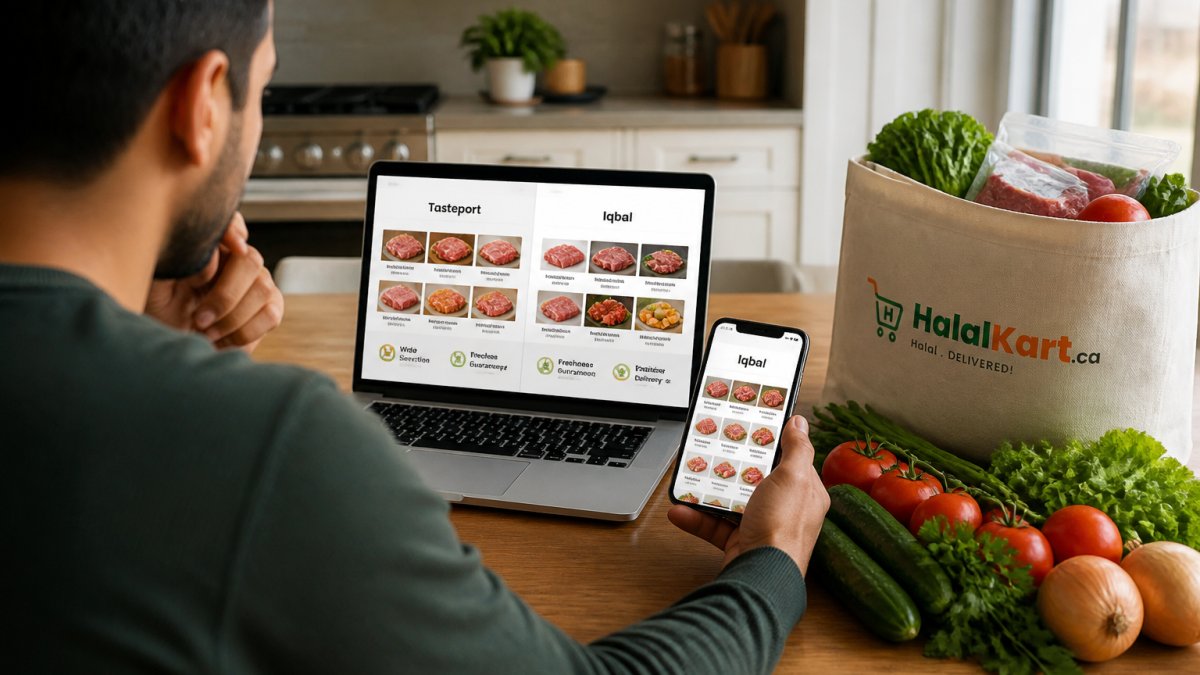
Neither model wins everywhere, and the right choice depends on your priorities and location. Test each row yourself before committing a weekly basket.
How to verify selection and freshness claims
Selection depth is easy to overstate online. A catalog can list an item that is out of stock at the fulfilling store. Before you rely on a category, check three things:
- Category depth, not just category presence. Search for the specific cuts, brands, or dietary items you buy weekly. A service that stocks one lamb cut is not the same as one that stocks five.
- Substitution policy. Ask whether the store substitutes a missing item, who chooses the substitute, and whether you are charged the difference. A vague answer is a red flag for perishables.
- Cold-chain packing. For dairy, frozen foods, and halal meat, ask how items are packed (insulated bags, ice packs, cooler totes) and how long the delivery window is. A late slot means cold items sit longer in transit.
What the comparison misses
No table can capture week-to-week variability. Promotions rotate, produce quality changes with the season, and delivery capacity tightens during busy periods. That is why the most useful comparison is a dated, like-for-like basket you build yourself, using the method below.
Iqbal Foods Online Grocery Delivery: What to Expect
Shoppers who already know a store may prefer its online delivery option to skip the trip.
Delivery fees, order minimums, and windows vary, so confirm them at checkout.
When ordering perishables, check the delivery window so cold items are not left in transit longer than necessary.
Halal Grocery Delivery: Fees, Minimums, and Fulfillment Compared
Halal grocery delivery costs vary by service, so compare current fees before ordering. Fees typically depend on basket size, delivery distance, and whether you hit the order minimum.
Watch out: the delivery fee is rarely the real cost.
Fulfillment speed is the other variable. Delivery capacity and zones can limit availability, so ask two questions before ordering: what is the minimum, and what is the latest delivery window for cold items?
How to Verify Halal Certification Before You Order
Verifying halal certification means checking three things: the certifying body, the certificate's validity, and whether the certificate covers the specific product you are buying. A logo alone proves nothing.
Here is the practical process:
- Identify the certifying organization named on the package or product page.
- Confirm the certifier is a recognized halal monitoring body.
- Check that the certificate is current and lists the actual product or supplier.
- Look for a traceability chain from supplier to shelf.
- Contact the retailer if any step is unclear.
For a full walkthrough, our guide on how to verify halal meat online takes you through each check in detail.
Buying Halal-Certified Meat Online: What to Check
Buying halal-certified meat online adds one layer of risk: you cannot see the cut before it ships. Check documentation before you check out.
Look for the certifier's name, not just a symbol. Confirm the certificate covers the specific cut and supplier, and check how the meat is packed and whether cold-chain delivery is stated.
Meat products should carry documentation tied to a recognized certifier. Our step-by-step guide on verifying halal meat certification shows exactly which documents to request.
Pricing and Basket Cost: A Fair Like-for-Like Method
Price comparisons often go wrong when shoppers compare different items or leave out delivery fees on one side. The fix is a dated, like-for-like basket with matched products, package sizes, and locations. Delivery rates vary, so the most reliable comparison is one you build and date yourself.
The like-for-like basket method
Use this sequence every time you compare, and write down the date and the postal code you used:
- Match the basket. Choose the same proteins, produce, pantry staples, dairy, and frozen items. Match package sizes (for example, the same weight of chicken or the same volume of milk), not just product names.
- Record the shelf price and the unit price. Unit price (per 100 g or per 100 mL) exposes package-size tricks that headline prices hide.
- Add the delivery fee to each total. If one service waives the fee above a threshold, note the threshold and whether your basket clears it.
- Apply promotions only if they apply to your basket. A sale on a brand you do not buy is not a saving. Note the promotion's end date.
- Account for substitutions. If an item was unavailable and was replaced, record the substitute's price and whether you were charged the difference.
- Divide by the number of items to get a per-item cost, and keep the raw notes so you can repeat the test next month.
A worked example (illustrative, not a quote)
To show how the method works, here is an illustrative basket structure. The amounts below are placeholders to demonstrate the math; replace them with prices you verify on the day you shop, and keep the date.
| Line item | Tasteport (illustrative) | Iqbal Foods (illustrative) |
|---|---|---|
| Halal chicken, same weight | Shelf price + unit price | Shelf price + unit price |
| Lamb cut, same weight | Shelf price + unit price | Shelf price + unit price |
| Produce (same items, same weights) | Shelf price + unit price | Shelf price + unit price |
| Dairy and milk (same volume) | Shelf price + unit price | Shelf price + unit price |
| Frozen items (same package sizes) | Shelf price + unit price | Shelf price + unit price |
| Pantry staples (same brands and sizes) | Shelf price + unit price | Shelf price + unit price |
| Delivery fee | Add if applicable | Add if applicable |
| Substitution adjustment | Note any difference | Note any difference |
| Basket total (CAD) | Sum of the above | Sum of the above |
| Per-item cost (CAD) | Total ÷ item count | Total ÷ item count |
When you fill this in with verified prices, compare the totals rather than headline figures. That is why the date and postal code matter: a basket that wins in one neighborhood one week can lose in another.
Fees, minimums, and fulfillment: what to confirm at checkout
Before you treat a basket total as final, confirm these at checkout and write them down:
- Delivery fee and free-delivery threshold. Ask whether the threshold is based on subtotal before or after promotions.
- Order minimum. A low minimum can encourage overbuying; a high minimum can make small baskets uneconomical.
- Delivery window and cold-chain handling. A late slot means perishables sit longer in transit. Order early in the day when you can.
Start Your Halal Grocery Order with Verified Products
For halal shoppers, verification matters as much as price and convenience. A basket is only useful if you can confirm what is in it.
That is where HalalKart fits. We run a rigorous 4-step verification process, with partnerships with recognized halal monitoring organizations.
Ready to shop? Browse our halal meat and poultry selection.
Frequently Asked Questions
What is the difference between Tasteport and Iqbal Foods?
Tasteport operates as an online-first grocery service, while Iqbal Foods centers on its physical store with online ordering as an add-on. The practical difference shows up in selection breadth, delivery coverage, and how each handles halal verification. Compare their current product assortment, delivery fees, and order minimums before choosing. If verified halal certification is your priority, check whether each service publishes its certification sources and audit process.
How can I check whether groceries are halal-certified?
Look for a certification mark from a recognized halal monitoring body on the package or product page, then confirm the certifier actually covers that product category. Ask the retailer how it verifies vendors: documentation review, site checks, and periodic audits are stronger signals than a logo alone. HalalKart uses a 4-step verification process and partners with organizations including HMA, ISNA, and IFANCA, so you can trace how each item was checked.
Can you order groceries from Iqbal Foods online?
Iqbal Foods offers online grocery delivery, but availability depends on your address and the current fulfillment setup. Before relying on it, confirm the delivery zone, order minimum, delivery fee, and whether fresh meat ships in temperature-controlled packaging. Compare that against halal grocery delivery from a dedicated marketplace, which may cover different areas or carry a different product range.
What should I compare before choosing an online halal grocery service?
Check four things: halal verification (who certifies and how often it is audited), product availability for your regular items, delivery coverage and fees including minimums, and like-for-like basket cost. Build a test basket of ten staples you buy weekly, price it on each service, and add delivery charges. That gives you a real cost comparison instead of judging by a few advertised deals.
The hardest part of switching grocery services is not learning a new app. It is trusting that what arrives matches what you ordered. HalalKart was built for exactly that gap: a halal-only marketplace with a 4-step verification process, documented vendor checks, and continuous monitoring through audits and community feedback. Get started with HalalKart and shop your full halal grocery list from one verified source.