 blog
Iqbal Foods Alternative for Online Shopping: HalalKart
Table of Contents
- Why Shoppers Are Searching for an Iqbal Foods Alternative
- Online Halal Grocery Shopping: What a Dedicated Marketplace Changes
- Halal Meat Delivery Online: Sourcing, Certification, and Cold Chain
- Pakistani Groceries Online: Finding the Brands You Grew Up With
- HalalKart as an Instacart Alternative for Halal Groceries
- Delivery Coverage, Fees, and Order Minimums Compared
- Substitutions, Freshness, and Order Accuracy: What to Expect
- Which Option Fits Your Household?
- Frequently Asked Questions
Last Updated: October 18, 2026
Why Shoppers Are Searching for an Iqbal Foods Alternative
Loyalty to a grocery store is rarely about the building, it's the butcher who knows your order and the aisle where the atta and basmati always sit.
That last point matters more than most shoppers realize.
Below, we break down what a dedicated online halal marketplace does differently, how it compares with general delivery apps, and which option suits which household.
Online Halal Grocery Shopping: What a Dedicated Marketplace Changes
Online halal grocery shopping works best when the platform is built around halal compliance rather than bolted onto a general store. A dedicated marketplace vets every vendor before listing them, then keeps checking.
HalalKart runs a four-step verification process combining background checks, documentation review, partnerships with recognized halal monitoring organizations, and ongoing audits with community feedback. We also work with HMA, ISNA and IFANCA, a halal claim is only as strong as the paperwork behind it.
How the 4-Step Verification Process Works
Verification is a sequence, not a single checkbox. Each step closes a gap the previous one leaves open.
- Vendor background check. We look at who is behind the business, not just what they sell.
- Documentation review. Certificates and sourcing records are examined before a product goes live.
- Certification alignment. We work with recognized halal monitoring bodies so claims trace to a standard, not a slogan.
- Ongoing monitoring. Periodic audits and community feedback keep listings honest after launch.
A common mistake is treating any halal logo as equal. Certification bodies differ in scope and rigor, and a facility certificate isn't the same as one for a specific product line. Ask which body certified what.
Halal Meat Delivery Online: Sourcing, Certification, and Cold Chain
Halal meat delivery online succeeds or fails on two things: traceable sourcing and an unbroken cold chain.
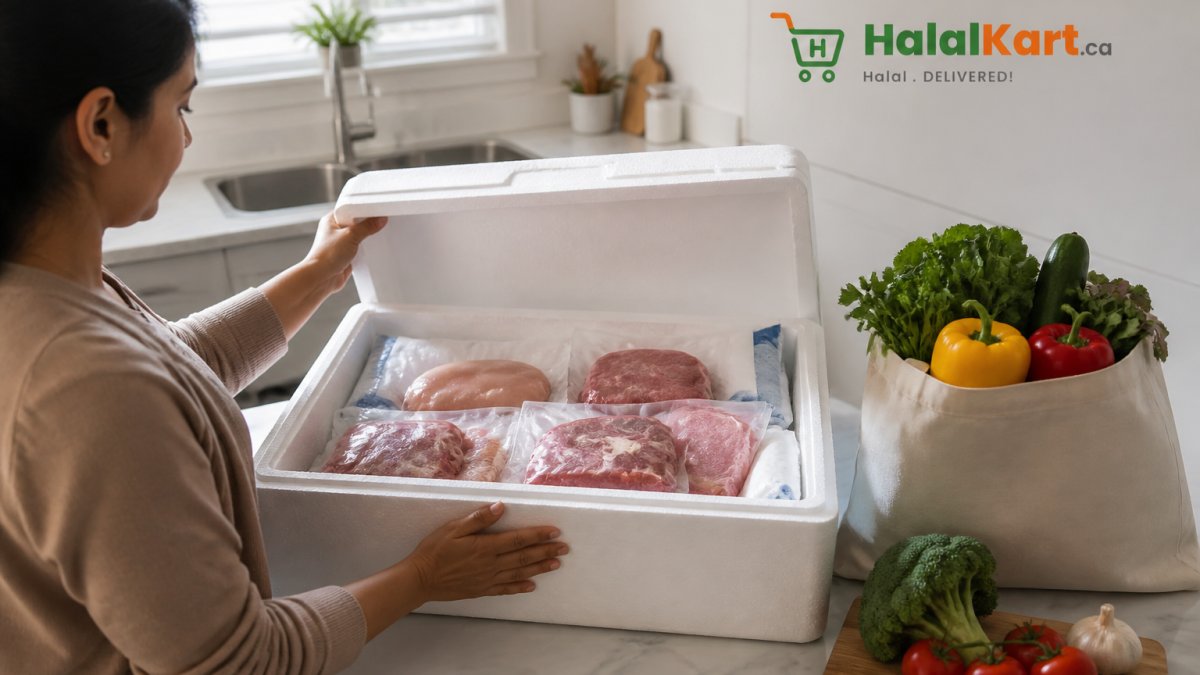
Insulated packaging and coolant packs buy time, but the clock starts at packing, not at your door, so delivery windows matter as much as the cut.
When you order, check three things: who certified the meat, how it's packed, and what the seller's policy is if a package arrives warm.
Pakistani Groceries Online: Finding the Brands You Grew Up With
Pakistani groceries online have matured to the point where the specialty aisle is no longer the weak spot.
That matters for second and third-generation shoppers in particular.
What separates a good specialty selection from a frustrating one is consistency.
Spices deserve their own note: authentic ingredients lose potency with age and poor storage, so a seller who moves stock quickly outperforms one with dusty shelves.
HalalKart as an Instacart Alternative for Halal Groceries
An Instacart alternative for halal groceries makes sense when verification, not just delivery speed, is the deciding factor.
A general app can deliver from a halal grocer, but it doesn't audit that grocer's supply chain, it's a courier, not a certifier.
HalalKart is a halal-only marketplace, so the entire catalogue clears one filter before you ever see it.
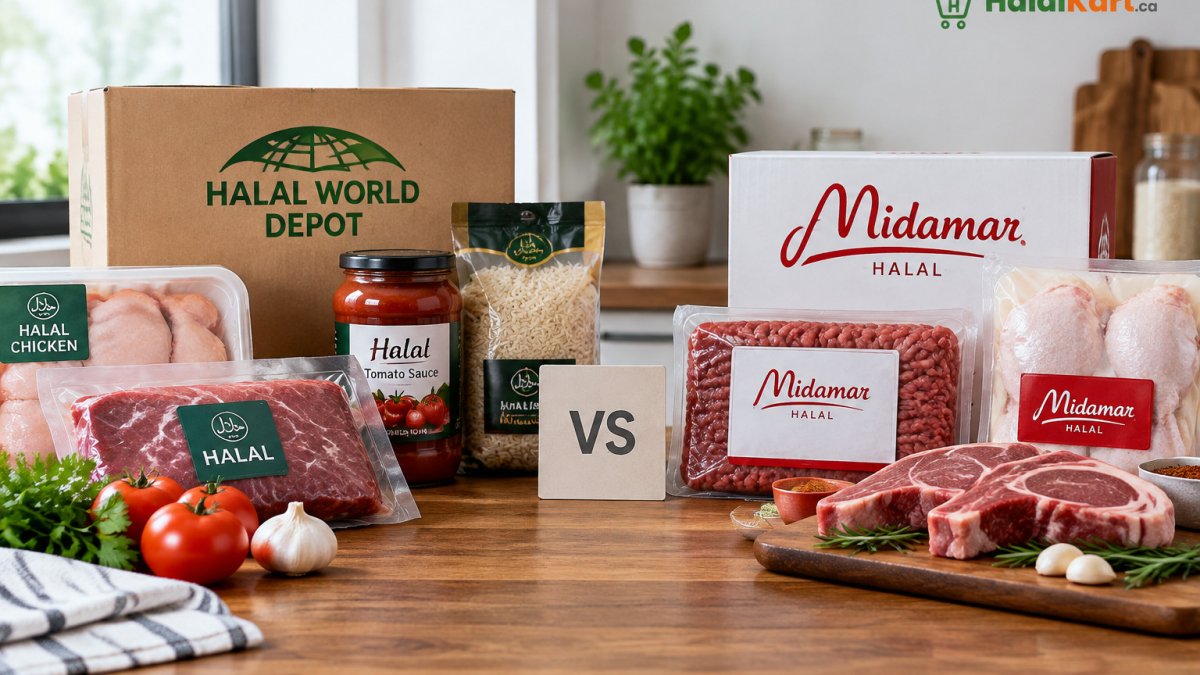
Side-by-Side: Marketplace vs. General Delivery App
| Factor | Dedicated Halal Marketplace | General Delivery App |
|---|---|---|
| Halal verification | Vendor and product review before listing | Depends on the individual store |
| Product range | Halal groceries, meat, pantry, lifestyle | Broad, general retail |
| Meat sourcing transparency | Certification and sourcing reviewed | Store-dependent, rarely documented |
| Specialty South Asian brands | Core inventory | Varies by participating store |
| Delivery coverage | Set by the marketplace | Set by store availability |
| Substitution policy | Platform-defined | Store or shopper-defined |
The table isn't a knockout. If you need a mop and a melon at 10 p.m., a general app wins on breadth. If you need to know exactly how your meat was certified, the dedicated route is the only one that answers.
Delivery Coverage, Fees, and Order Minimums Compared
Delivery coverage, fees and order minimums decide whether an online grocery alternative actually works for your household, and they're the numbers most comparison pages skip. A platform can have a flawless halal selection and still be useless if it doesn't reach your postal code or its minimum pushes your basket past what you'd spend in store.
Coverage: check the postal code, not the city
Most platforms advertise by city, but coverage is decided at the postal-code level. Two households in the same municipality can have very different experiences: one inside a dense delivery zone with same-day windows, the other outside it with a two-day lead time or no service.
Specialty and halal-focused grocers typically concentrate coverage in denser areas first, so suburban and rural shoppers should confirm coverage before building a basket, not after.
Fees: separate the delivery fee from the service fee
Delivery pricing usually has more than one line. Watch for:
- Delivery fee, often tiered by basket size, distance, or delivery window. A small basket may carry a higher fee than a full weekly shop.
- Service or handling fee, a percentage or flat charge added at checkout, separate from delivery.
- Small-order fee, applied when your basket falls below a threshold, on top of the delivery fee.
Add every line before you compare. A platform with a lower headline delivery fee but a service fee and a small-order fee can cost more per trip than one with a single, slightly higher delivery charge.
Minimum orders: the threshold that shapes your basket
Minimum-order thresholds exist because a delivery route has to be worth running, and they're the most common reason shoppers abandon a basket at checkout. Note the minimum for home delivery specifically, pickup minimums are often lower or nonexistent, and check whether it counts before or after discounts and fees.
A practical test: build your normal weekly basket on each platform and see whether it clears the minimum without padding. If you have to add items you don't need, the effective cost per item is higher than the sticker price suggests.
Delivery windows: how narrow, how far out
Window structure tells you how the platform plans routes. Same-day windows are convenient but usually carry a surcharge and vanish first on busy days; next-day is standard.
Ask two questions: how far in advance can I book, and what happens if my window is missed? A platform that flags a delay before the window closes beats one that leaves you guessing.
Build a total-cost comparison, not a fee comparison
The only number that matters is the full cost of your actual weekly basket: item subtotal, plus delivery, service and small-order fees, plus any packaging charge, minus any discount. Run that calculation for two or three platforms using the same basket. The winner is usually not the lowest delivery fee, but the platform whose minimum, fees and window structure fit how your household shops.
What to confirm before your first order
- Your postal code is inside the delivery zone.
- The minimum order is reachable with your normal basket, not a padded one.
- Every fee line is visible before checkout, not added at the final step.
If a platform cannot answer those five points clearly, the fee comparison is academic, the service will not fit your week regardless of price.
Substitutions, Freshness, and Order Accuracy: What to Expect
Substitutions, freshness and order accuracy are where online grocery shopping earns or loses trust, and the differences show up on delivery day, not at checkout.
Ask what happens when an item is out of stock. Some platforms let you set preferences in advance.
If something arrives wrong, report it the same day, most platforms have a claims window, and fresh items are time-sensitive.
Which Option Fits Your Household?
Most comparison articles end with a vague 'it depends.' Here's a recommendation organized by what you actually need, halal certainty, specialty products, budget, or coverage, rather than by which platform has the loudest marketing.
Start with your hardest requirement, not your easiest
Every household has one requirement that, if unmet, makes the rest of the comparison irrelevant. Identify it first, then filter platforms against it before looking at price or selection.
- If halal provenance is the non-negotiable: a dedicated halal marketplace is the only category that documents vendor vetting and product-level certification. General delivery apps can deliver from a halal grocer, but they do not audit that grocer's supply chain. If you need to know which body certified which product line, the dedicated route is the only one that answers the question.
- If a specific South Asian or Pakistani brand is the requirement: check category-level availability before anything else. Search the exact brand and pack size on each platform. A platform that carries the brand occasionally is worse than one that treats it as core inventory, because you cannot build a weekly shop around intermittent stock.
- If budget is the binding constraint: compare total basket cost, not delivery fees. A platform with a higher delivery charge but a lower item subtotal and a reachable minimum often wins on a full weekly shop.
Match the platform to the shopping job
Households rarely have one shopping job. They have several, and the smartest approach is to stop treating the decision as a permanent switch.
- The weekly staple shop, atta, basmati, oil, spices, pantry staples, is the job a dedicated halal or South Asian grocery marketplace handles best, because those lines are core inventory rather than seasonal experiments.
- The fresh meat order is the job where verification and cold-chain discipline matter most. Use the platform that can tell you who certified the meat, how it is packed, and what its policy is if a package arrives warm.
- The top-up and general household run, a mop, a melon, a last-minute item, is the job a broad delivery app covers with less certainty on sourcing but more breadth and speed.
A decision path you can run in ten minutes
- Write down your one non-negotiable. Halal certification, a specific brand, budget, or coverage.
- Filter platforms against it. Eliminate any platform that cannot meet it, regardless of price.
- Confirm coverage for your postal code on the remaining platforms.
- Build your normal weekly basket on each and note the minimum-order threshold.
- Add every fee line, delivery, service, small-order, packaging, to get a true total.
- Check the delivery window structure against the day you actually shop.
- Place one small test order with a fresh, a frozen and a pantry item before committing to a recurring slot.
The honest recommendation
For most halal households, the hardest question is provenance, the question a dedicated halal marketplace is built to answer. Use it for the weekly staple shop and the meat order, where verification and specialty selection carry the most weight.
To hold a platform to a standard rather than take a claim on faith, start with the verification question: can the seller show you, in plain language, how halal status is checked from vendor to doorstep?
Frequently Asked Questions
What should I look for in an online halal grocery store?
Check three things before your first order: who certifies the meat and whether the certifier is named on the product page, how the store vets its vendors (documentation reviews and audits beat a logo on a homepage), and what happens if an item arrives wrong. HalalKart publishes its 4-step verification process and works with recognized halal monitoring organizations, so you can trace how a product was approved rather than taking a badge at face value. Also confirm delivery coverage and order minimums for your postal code before building a full basket.
Can I order halal meat and groceries online in one delivery?
Yes, on a dedicated halal marketplace you can combine fresh meat, pantry staples, produce, and household items in a single basket. That is the main practical difference from ordering meat from a butcher and groceries from a general delivery app, which means two orders, two fees, and two delivery windows. HalalKart is built as a halal-only marketplace, so meat, Pakistani groceries online, and everyday essentials ship together. Confirm the cold-chain packaging details for your area when you check out.
How can I check whether groceries are halal-certified?
Look for a named certifying body on the packaging or product listing, not just the word "halal." Certification should come from a recognized monitoring organization, and the store should be able to tell you which one backs a given product. For meat, ask about sourcing and slaughter method. HalalKart reviews vendor documentation and runs periodic audits, and it partners with organizations such as HMA, ISNA, and IFANCA. If a listing is unclear, contact the store before ordering rather than assuming.
What is the difference between a grocery marketplace and a delivery app?
A delivery app typically connects you to general supermarkets and leaves halal verification to the individual store, so you are trusting each retailer's labeling. A dedicated marketplace curates vendors and applies its own verification standard across every listing. That matters most for meat, where sourcing and certification are hard to confirm from a product photo. The trade-off is product range: a general app may carry more mainstream brands, while a halal marketplace focuses on certified products and specialty imports.