 How-to
9 Questions to Ask Halal Meat Suppliers Before You Buy
Last Updated: October 28, 2026
Quick Summary
Ask halal meat suppliers who certifies their meat and for a copy of the certificate, which slaughter method they follow, how animals are fed and reared, and how they trace and segregate products. A serious supplier provides documentation quickly, while vague answers about certification or slaughter are a red flag.
- A trustworthy supplier names a specific certifying body and shares the certificate without hesitation.
- Ask whether animals are stunned, who performs slaughter, and which scholarly position the certifier follows.
- Request batch records, certificate numbers, country of origin, and supply chain partners for traceability.
- Segregation controls must cover processing, storage, transport, and handling to prevent cross-contamination.
- HalalKart partners with recognized halal monitoring organizations including HMA, ISNA, and IFANCA.
Table of Contents
- Why the Right Questions Separate Trusted Halal Meat Suppliers From the Rest
- 1. Who Certifies Your Halal Meat, and Can I See the Certificate?
- 2. Is Your Meat Zabiha or Dhabihah, and What Slaughter Method Do You Follow?
- 3. What Do Your Animals Eat, and How Are They Reared?
- 4. How Does Halal Meat Traceability Work From Farm to Delivery?
- 5. How Do You Keep Halal Meat Separate From Non-Halal Products?
- 6. Your Halal Supplier Checklist: What Documentation Should They Provide?
- 7. What Are Their Halal Meat Handling and Storage Standards?
- What to Do With the Answers You Get
- Frequently Asked Questions
Why the Right Questions Separate Trusted Halal Meat Suppliers From the Rest
Most people pick halal meat suppliers the same way they pick a gas station: it's close, it looks fine, and they never think about it again. That works until it doesn't. The difference between a supplier you can trust and one you can't rarely shows up on the label. It shows up in the answers they give when you ask hard questions.
At HalalKart, we built our marketplace around a four-step verification process. We review vendor documentation and conduct periodic audits, with community feedback as part of our ongoing monitoring. When evaluating a halal meat supplier, ask what verification steps they use.
Below, we break down the nine questions that matter most, plus a checklist you can bring to your next conversation. Ask them in order. A supplier who stumbles on question one rarely gets better by question nine.
1. Who Certifies Your Halal Meat, and Can I See the Certificate?
A trustworthy halal meat supplier names a specific certifying body and hands over a copy of the certificate without hesitation. Vague answers like "we're all halal here" or "our butcher handles it" are a red flag.
Halal certification is a formal review of a supplier's sourcing, slaughter, and handling by a recognized third party. The certifier matters as much as the certificate. Look for a body that inspects the actual processing facility, not just the retailer.
Ask these follow-ups:
- Which certifying body issued the certificate?
- What is the certificate's scope and expiry date?
- Can you see the certificate for the specific product I'm buying?
How to Verify Halal Meat Certification Beyond the Logo
A logo on packaging proves nothing on its own. Anyone can print a crescent moon. Real certificate validity checks happen at the source.
Start with the certifier's own records. For a full walkthrough, see how to verify halal meat certification. Most recognized bodies publish a directory of certified facilities you can search by name. Then compare the certificate's scope against what you're actually buying. A certificate for chicken does not cover beef. A certificate for a processing plant does not cover a farm.
2. Is Your Meat Zabiha or Dhabihah, and What Slaughter Method Do You Follow?
The answer should be immediate and specific. If a supplier can't explain their slaughter method in plain terms, they don't control it.
Zabiha and dhabihah both refer to the Islamic method of slaughter: a swift, humane cut that severs the blood vessels while the animal is alive, with a pronouncement of God's name. Schools of thought differ on details like stunning, mechanical slaughter, and who performs the act. That's why the question isn't "is it halal?" It's "which method, and who does it?"
Ask for:
- Whether the animal is stunned before slaughter, and how
- Who performs the slaughter and whether they are Muslim
- Whether the pronouncement is made on each animal or in bulk
- Which scholarly position the certifier follows
Suppliers who respect their customers will answer all four. Suppliers who dodge are telling you something.
3. What Do Your Animals Eat, and How Are They Reared?
Animal feed and animal welfare are part of halal, not separate from it. A halal claim that ignores how the animal lived is incomplete.
Feed matters because some ingredients are not permissible, and cross-contact with non-halal feed ingredients needs to be controlled. Ask whether the feed contains animal by-products, and if so, from which species. Ask whether the feed is verified by the certifier or simply assumed.
On rearing, ask about grass-fed versus grain-finished, access to pasture, and the water source. These affect product quality and taste, and they tell you how seriously the supplier takes the whole chain.
A common mistake is treating these as premium extras. For deeper context, explore the benefits of locally sourced halal meat. In practice, they're baseline questions for anyone who cares about animal welfare and traceability.
4. How Does Halal Meat Traceability Work From Farm to Delivery?
Halal meat traceability is the ability to follow a product from the farm through processing, storage, and delivery. If a supplier can't trace a cut back to its source, they can't guarantee it stayed halal the whole way.
Ask what records they keep:
- Batch records linking each product to a specific processing run
- Product documentation showing the certifier and certificate number
- Country of origin for the animal
- Supply chain partners, including any third-party processors
Traceability is also a food safety tool. When something goes wrong, the supplier with good records can issue a recall quickly. The one without records finds out from a customer complaint.
5. How Do You Keep Halal Meat Separate From Non-Halal Products?
Segregation is where many otherwise good suppliers fall apart. The question is simple: how do you prevent cross-contamination with non-halal meat, pork, or alcohol at every stage? It also helps to learn about preventing meat cross contamination at home so you can judge their separation practices.
Walk through the chain with them:
- Processing facility: dedicated lines, dedicated equipment, or verified cleaning between runs?
- Storage conditions: separate coolers, labeled shelving, sealed containers?
- Transport conditions: dedicated vehicles or shared loads with sealed separation?
- Handling procedures: trained staff, gloves, tools, and color-coded equipment?
A supplier who handles halal and non-halal products in the same space needs to explain their controls in detail. "We're careful" is not a control. Hold suppliers to the same standard.
6. Your Halal Supplier Checklist: What Documentation Should They Provide?
A serious halal meat supplier should hand over documentation before you ask twice. Use this checklist on your next call or visit.
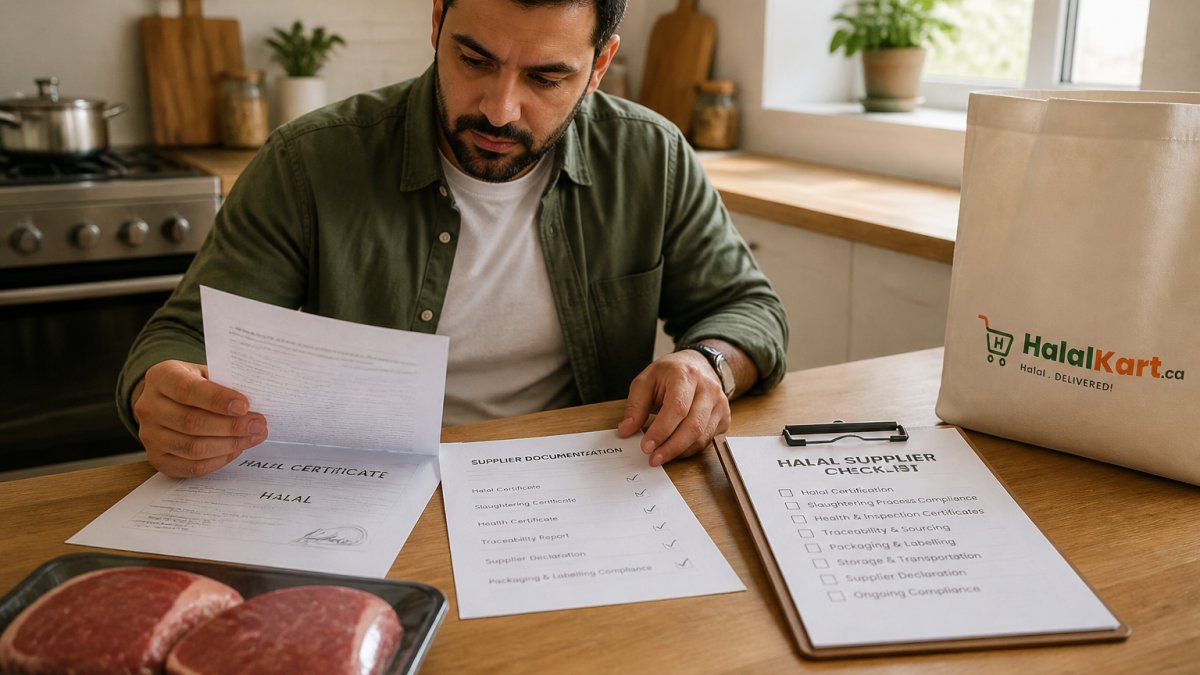
- Current halal certificate with certifier name, scope, and expiry date
- Certificate number you can match against the certifier's directory
- Written slaughter method statement, including stunning policy
- Feed ingredient declaration and any certifier verification
- Farm and processing facility names and locations
- Batch records or lot numbers for the products you're buying
- Segregation and cleaning procedures for shared facilities
- Storage and transport temperature logs
- Recall procedure and a named contact for complaints
- Insurance and food safety documentation where applicable
If a supplier can produce most of this quickly, you're dealing with a professional operation. If they promise to "send it later" and never do, you have your answer.
7. What Are Their Halal Meat Handling and Storage Standards?
Halal meat handling and storage standards protect both religious integrity and food safety. Ask how the supplier manages temperature, packaging, and time from processing to your door.
Look for clear answers on:
- Storage conditions: cooler and freezer temperatures, monitored and logged
- Packaging: sealed, labeled, and dated at the point of processing
- Delivery: insulated containers, cold packs, and delivery windows that keep meat in the safe zone
- Quality control: inspections, staff training, and record keeping
Ask how the supplier packs fresh meat and what happens if a delivery is delayed.
What to Do With the Answers You Get
You now have nine questions and a checklist. Use them to assess the information a supplier provides.
At HalalKart, we use background checks and documentation reviews for vendors, partner with recognized halal monitoring organizations including HMA, ISNA, and IFANCA, and monitor through periodic audits and community feedback.
Ready to shop? Browse our verified halal marketplace.
Frequently Asked Questions
How can I verify that a meat supplier is halal-certified?
Ask for the certificate itself, not just a logo on packaging. Check the certifying body's name, the products and facilities the certificate covers, and its expiry date. Then confirm the certifying body is recognized and contact them directly to validate the certificate number. Cross-check the scope against what you are actually buying.
What should I ask about halal meat sourcing and traceability?
Ask which farm and processing facility the meat came from, whether batch records exist, and whether the supplier can link a package to a specific production run. Request country of origin and documentation for each shipment.
How can I find out whether halal meat is handled separately from non-halal meat?
Ask directly about segregation at every stage: slaughter, processing, storage, transport and packing. Request details on dedicated equipment, separate storage areas, and cleaning procedures between runs. Confirm whether pork or alcohol is handled in the same facility.
What questions should I ask about slaughter practices?
Ask whether the meat is zabiha or dhabihah, who performs the slaughter, whether the animal is facing the qibla, and whether the tasmiyah is recited. Confirm the animal is alive at the time of slaughter and that the method follows the standard you accept. Different schools of thought interpret some details differently, so ask for specifics rather than a yes or no.