 how-to
Preventing Meat Cross Contamination at Home
Table of Contents
- Preventing Meat Cross Contamination at Home: Essential Steps
- How Contamination Spreads in Your Kitchen
- Step 1: Master Hand Hygiene Before and After Handling Raw Meat
- Step 2: Separate Raw and Cooked Foods in Your Shopping and Fridge
- Step 3: How to Store Raw Meat in the Fridge Safely
- Step 4: Clean and Sanitize Surfaces, Utensils, and Cutting Boards
- Step 5: Cook Meat to Safe Internal Cooking Temperatures for Meat
- Step 6: Proper Use of Meat Thermometers for Accuracy
- Common Mistakes That Cause Cross Contamination
- Frequently Asked Questions
Last Updated: October 3, 2026
Preventing Meat Cross Contamination at Home: Essential Steps
Preventing meat cross contamination at home starts with one rule: keep raw meat and its juices away from everything else. This guide from HalalKart walks through the exact steps, from store to cutting board.
Meat cross contamination is the transfer of harmful bacteria from raw meat, poultry, or seafood to ready-to-eat foods, surfaces, or utensils. It is a leading cause of foodborne illness in home kitchens, and it usually happens unnoticed, a drip on a shelf, a shared knife, or an unwashed hand.
How Contamination Spreads in Your Kitchen
Contamination spreads through three main paths: direct contact, drips, and shared tools.
- Direct contact: Raw meat touches a counter, then a vegetable lands on the same spot.
- Dripping juices: A package of raw poultry leaks onto the shelf below in the fridge.
- Shared tools: The same knife or board handles raw meat and then salad greens.
- Hands and cloths: Unwashed hands or a reused sponge move bacteria from one surface to another.
Pathogens like Salmonella and E. coli need a carrier, a surface, a hand, or a tool. The fix is physical separation: keep raw meat away from other foods, and clean anything it touches right away.
Step 1: Master Hand Hygiene Before and After Handling Raw Meat
Wash your hands with warm soapy water for at least 20 seconds before and after touching raw meat. This single habit blocks more cross contamination than any other step.
A common mistake is a quick rinse with no soap. Soap lifts bacteria off your skin so water can carry it away. Wash again after handling raw meat, and never dry your hands on the towel you used on a meat counter.
Step 2: Separate Raw and Cooked Foods in Your Shopping and Fridge
Keep raw meat, poultry, and seafood in separate bags from ready-to-eat foods at every stage. Physical separation is the backbone of safe food handling, from store to fridge.
At the store:
- Place raw meat in a plastic bag before it goes in your cart.
- Keep raw meat away from produce, bread, and deli items.
- Bag raw meat separately at checkout.
At home, unpack raw meat first and put it away immediately. If a package is leaking, bag or wrap it again before it goes in the fridge.
Step 3: How to Store Raw Meat in the Fridge Safely
Store raw meat on the bottom shelf of the fridge in a sealed container or on a rimmed tray, so drips cannot reach foods below.
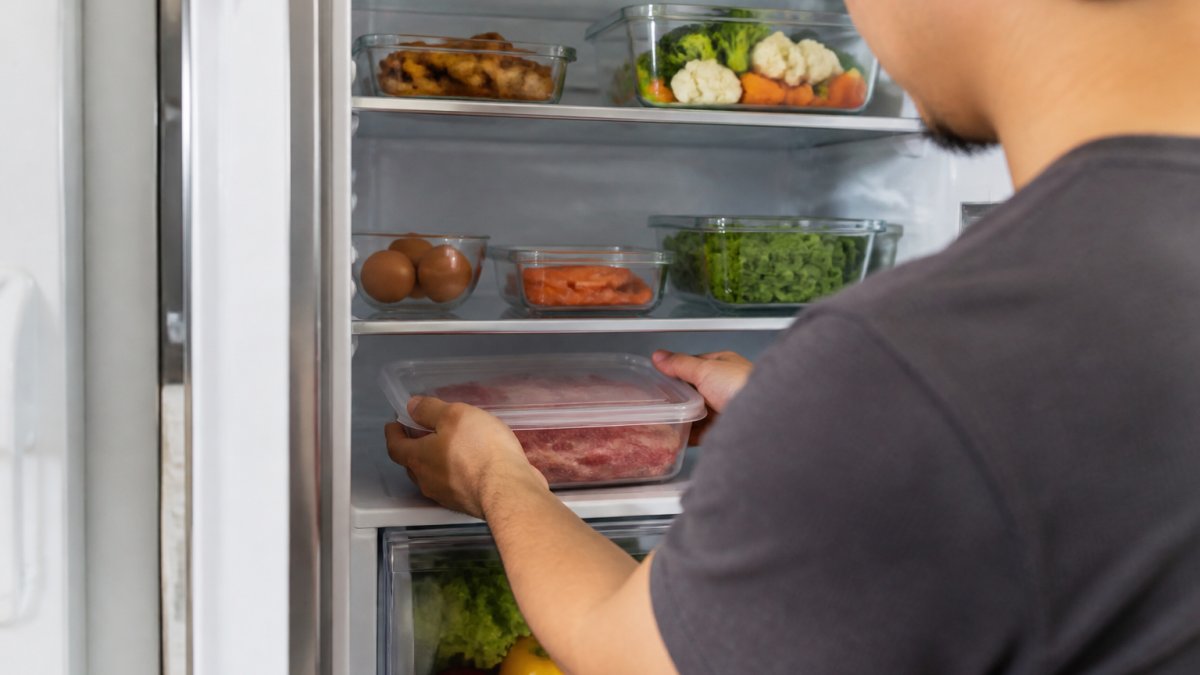
Follow these storage rules:
- Bottom shelf only: Poultry, ground meat, and seafood go on the lowest shelf.
- Sealed or on a tray: Use a lidded container or a rimmed tray to catch juices.
- Cool it fast: Refrigerate raw meat within two hours of purchase, or sooner in warm weather.
- Label and date: Write the date on the package so you use older items first.
A common mistake is storing raw meat above ready-to-eat foods; one drip onto salad or leftovers contaminates food that will never be cooked again.
Step 4: Clean and Sanitize Surfaces, Utensils, and Cutting Boards
Clean and sanitize every surface, utensil, and cutting board that touches raw meat before it touches anything else. Cleaning removes germs and grease; sanitizing kills the bacteria cleaning leaves behind. You need both, in that order, as a sanitizer applied to a greasy surface cannot reach the bacteria underneath.
The two-step method, every time:
- Wash with warm soapy water to lift food, fat, and bacteria off the surface.
- Sanitize with a food-safe sanitizer and let it sit for the full contact time before wiping or air-drying.
Most home cooks skip the contact time, but a sanitizer needs time to work. Follow the label's stated contact time, usually 30 seconds to 10 minutes.
Sanitizer options that work in a home kitchen
- Diluted unscented household bleach: Mix 5 mL (1 teaspoon) of bleach into 750 mL (3 cups) of cool water. Make it fresh daily, because bleach loses strength once diluted. Let it sit at least one minute, then air-dry or wipe with a clean cloth.
- Quaternary ammonium sanitizer: Common in commercial kitchens and sold for home use. Follow the label dilution and contact time. Do not mix it with bleach.
- Hydrogen peroxide-based sanitizer: Gentler on some surfaces and effective against a broad range of bacteria. Also needs its full contact time.
- Dishwasher sanitizing cycle: A sanitize or high-temperature cycle can sanitize cutting boards, utensils, and plates; the final rinse typically reaches 71°C (160°F) or higher. Confirm your model meets that threshold.
Never mix bleach with vinegar, ammonia, or any other cleaner. The combination can release toxic gas.
Material-specific protocols
Different materials hold bacteria differently, and the right cleaning method depends on the surface.
| Material | Clean With | Sanitize With | Key Watch-Out |
|---|---|---|---|
| Plastic cutting board | Warm soapy water and a scrub brush | Diluted bleach, quat sanitizer, or dishwasher sanitize cycle | Deep knife grooves trap bacteria. Replace the board when grooves are visible and cannot be scrubbed clean. |
| Wood cutting board | Warm soapy water, then dry fully | Food-safe sanitizer, or a vinegar-then-hydrogen-peroxide spray | Never soak wood. Moisture cracks the grain and creates hiding places. Re-oil with food-grade mineral oil when the surface looks dry. |
| Bamboo cutting board | Warm soapy water, quick rinse, dry immediately | Food-safe sanitizer | Bamboo is dense but still porous. Do not put it in the dishwasher. |
| Stainless steel | Warm soapy water | Food-safe disinfectant | Easy to sanitize, but scratches can harbor bacteria. Use a non-abrasive pad. |
| Countertop (laminate, quartz, granite) | Warm soapy water | Food-safe disinfectant matched to the surface | Avoid bleach on natural stone; it can etch the finish. Use a stone-safe sanitizer. |
| Sink basin | Warm soapy water and a scrub | Diluted bleach or a sink-specific sanitizer | The sink is one of the most contaminated spots in the kitchen. Sanitize it after every raw meat session, not just the counters. |
| Sponges and cloths | Dishwasher sanitize cycle, or microwave a damp sponge for one minute | Replace or sanitize often | A wet sponge is a bacteria reservoir. If it smells, replace it. |
Cutting board rules that actually prevent cross contamination
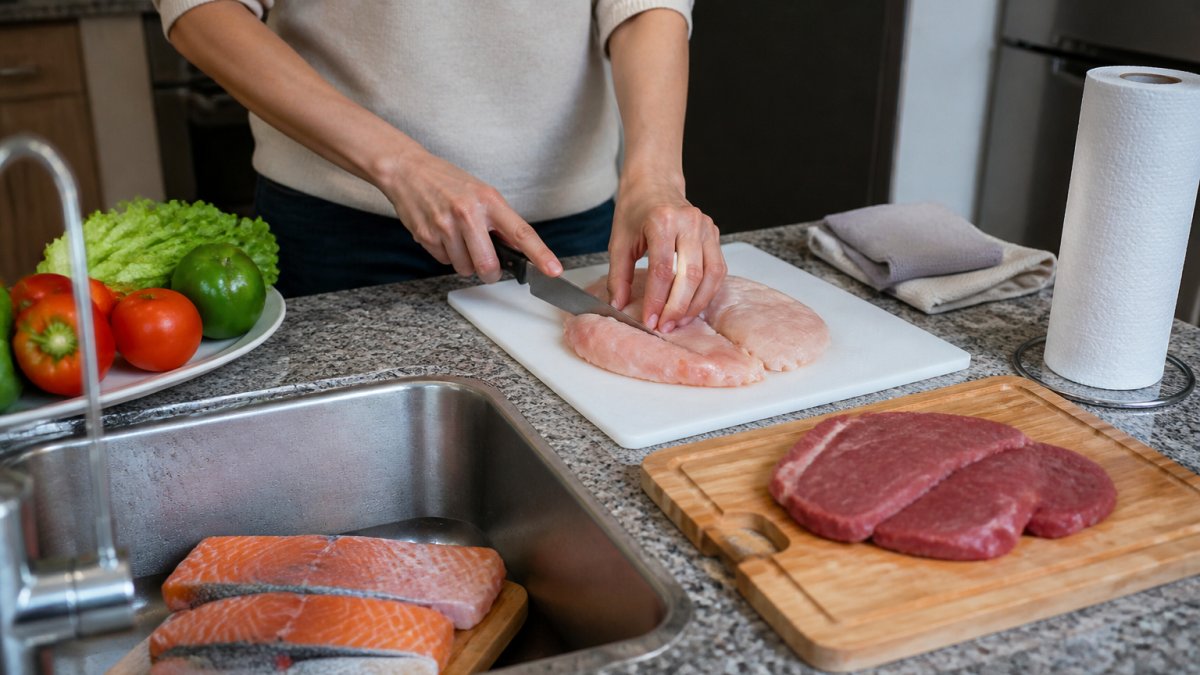
Use separate cutting boards for raw meat and for produce or cooked foods. This is the single most effective tool-level change you can make. Color-coded boards make the rule automatic: red for raw meat, green for produce, yellow for poultry, blue for seafood, white for dairy and bread.
If you only have one board, wash and sanitize it between every use, and never set cooked food on a board that just held raw meat.
Wood versus plastic, honestly:
- Plastic is easier to sanitize and dishwasher-safe, but knife scars hold bacteria if you do not scrub them out.
- Wood has natural antibacterial properties that some research supports, but it is harder to sanitize fully and cannot go in the dishwasher.
- Replace any board that is deeply scored, cracked, or warped; a worn board cannot be reliably cleaned.
Utensils, thermometers, and small tools
- Wash knives, tongs, spatulas, and thermometer probes with warm soapy water after they touch raw meat, then sanitize.
- Clean the thermometer probe between every reading; a probe that goes from raw chicken into a cooked roast can move bacteria onto food about to be served.
- Do not reuse a plate that held raw meat for cooked meat unless it has been washed and sanitized first, a common mistake at backyard grills.
Step 5: Cook Meat to Safe Internal Cooking Temperatures for Meat
Cooking meat to a safe internal temperature kills harmful bacteria. Color is not a reliable test. A burger can look brown and still be undercooked.
Safe internal cooking temperatures for meat:
- Poultry, including ground poultry: 74°C (165°F)
- Ground meat, such as beef, pork, or lamb: 71°C (160°F)
- Whole cuts of beef, pork, veal, and lamb: 63°C (145°F), then rest for 3 minutes
- Fish and seafood: 63°C (145°F)
These temperatures follow Health Canada's safe cooking temperature guidance. Always check the thickest part of the meat, away from bone and fat.
For halal cooking, reaching these temperatures does not affect the meat's halal status. Halal rules govern how the animal is slaughtered and handled, not how you cook it.
Step 6: Proper Use of Meat Thermometers for Accuracy
A meat thermometer is the only reliable way to know meat is cooked safely; guessing by color or time leads to overcooked or unsafe meat.
How to use a meat thermometer the right way:
- Insert the probe into the thickest part of the meat.
- Avoid bone, fat, and gristle, which give false readings.
- Wait for the reading to steady before you read it.
- Clean the probe with warm soapy water after each use.
For thin cuts like cutlets or patties, insert the probe from the side. Calibrate now and then with an ice-water test: a probe in ice water should read 0°C (32°F). If it does not, adjust or replace it.
Common Mistakes That Cause Cross Contamination
Most cross contamination at home comes down to a handful of repeat mistakes. Fix these and you remove the biggest risks, but mistakes still happen, so this section also covers what to do when contamination has already occurred.
The mistakes that cause most problems
- Rinsing raw meat in the sink. Splash spreads bacteria across your kitchen. Pat it dry instead.
- Reusing a cutting board or knife. Wash and sanitize between raw meat and other foods.
- Storing raw meat above ready-to-eat foods. Drips fall downward. Keep raw meat on the bottom shelf.
- Wiping hands on a shared towel. Use a paper towel or a dedicated cloth.
- Skipping the sanitize step. Soap cleans; a sanitizer kills what is left.
- Tasting marinade that touched raw meat. Never reuse it unless you boil it first.
- Thawing meat on the counter. Thaw in the fridge, in cold water, or in the microwave.
- Setting cooked meat back on the raw-meat plate. At the grill, this is the most common slip. Use a clean platter.
- Reusing a sponge that wiped up raw meat juice. Sanitize or replace it before it touches another surface.
What to do if you have already cross-contaminated
1. Stop and isolate. Do not move the contaminated food or surface around the kitchen.
**2. [Placeholder for step 2]
3. Wash your hands first. Warm soapy water for at least 20 seconds, before you touch anything else, including the sanitizer bottle.
4. Decide the fate of the contaminated food.
- If raw meat juice touched a ready-to-eat food (salad, fruit, bread, deli meat, leftovers), throw that food out. Do not try to rinse it, cook it, or serve it. There is no safe way to rescue ready-to-eat food that has contacted raw meat juice.
- If raw meat juice touched raw produce that will be cooked to a safe internal temperature, it can usually be cooked and eaten, provided it reaches the right temperature.
- If raw meat juice touched only surfaces, utensils, or packaging, clean and sanitize those items and continue.
**5. [Placeholder for step 5]
**6. [Placeholder for step 6]
7. Replace or sanitize the sponge and towel. A sponge that wiped up raw meat juice is now a contamination source.
8. Wash your hands again. After cleanup, before you touch any food.
**9. [Placeholder for step 9]
A quick decision rule
When you are not sure whether something is contaminated, ask one question: will this food be cooked to a safe internal temperature before it is eaten?
- If yes, and the contamination was raw meat juice, cooking will kill the bacteria as long as the food reaches the right temperature.
- If no, throw it out. The cost of one salad is far lower than a foodborne illness.
How to prevent the next one
The emergency steps above are a backup, not a plan. The real fix is a workflow that makes contamination hard to cause:
- Prep raw meat last. Do all chopping, slicing, and salad work first, then handle raw meat, so the raw-meat session is the final task before cleanup.
- Set up a raw-meat zone. Keep raw meat on one board, in one area of the counter, with its own knife and towel. Everything outside that zone stays clean.
- Clean as you go. Sanitize the board, knife, and counter the moment you finish with raw meat.
- Use a checklist for big meals. A simple order of operations (produce first, raw meat last, cook, then plate) prevents the split-second decisions that cause most mistakes.
Frequently Asked Questions
How can I avoid cross contamination when handling raw meat?
Always wash your hands with warm soapy water for at least 20 seconds before and after touching raw meat. Use separate cutting boards and utensils for raw meat and ready-to-eat foods. Keep raw meat wrapped and stored on the bottom shelf of your fridge to prevent dripping juices onto other items. Clean and sanitize all surfaces that come into contact with raw meat immediately after use.
What are the 5 ways to prevent cross contamination?
1) Wash hands thoroughly with soap and water. 2) Separate raw and cooked foods in your shopping cart, fridge, and preparation areas. 3) Use different cutting boards for raw meat and produce. 4) Clean and sanitize surfaces, utensils, and hands after contact with raw meat. 5) Cook meat to safe internal temperatures to kill harmful bacteria.
Can you reuse a cutting board after cutting raw meat?
You can reuse a cutting board after cutting raw meat only if you wash it thoroughly with hot, soapy water and then sanitize it. For plastic boards, a diluted bleach solution or dishwasher cycle works well. Wooden boards are more porous and require careful cleaning; some experts recommend having a separate board just for raw meat to reduce contamination risk.
How should you sanitize kitchen surfaces after preparing raw meat?
First, clean visible debris with warm soapy water. Then apply a food-safe sanitizer, such as a diluted bleach solution (1 tablespoon of unscented bleach per 4 liters of water) or a commercial kitchen sanitizer. Let it sit for the recommended contact time, then wipe dry with a clean cloth or let air dry. Always sanitize countertops, cutting boards, and utensils that touched raw meat.