 How-to
Why Choose Verified Halal Meat Delivery: A 2026 Guide
Table of Contents
- Why Verified Halal Meat Delivery Is Worth It
- How to Check Halal Certification Before You Order
- Halal Meat Processing Standards That Actually Matter
- What Halal Meat Delivery Service Reviews Reveal
- Halal Meat Storage and Handling After Delivery
- Delivery Coverage, Cost, and Value Compared
- Your First Order: A Step-by-Step Walkthrough
- Frequently Asked Questions
Last Updated: October 19, 2026
Why Verified Halal Meat Delivery Is Worth It
Verified halal meat delivery means a third party has checked the animal, the slaughter, and the handling before the product reaches your door.
This guide from HalalKart covers how to confirm a seller's credentials, what processing standards actually mean, and how to judge a delivery service on safety rather than marketing.
Here is the core tension. Halal labels are not all equal. Different certifiers apply different standards, and some sellers use the word loosely.
How to Check Halal Certification Before You Order
Start with the certifier's name, not the seller's claim. A legitimate listing names the body that certified the meat and shows a certificate number or logo you can trace.
Halal certification is an independent review confirming that a product and its supply chain meet a defined halal standard. It covers sourcing, slaughter method, and separation from non-halal products.
Here is how we would check any seller:
- Find the certifying body's name on the product page or packaging.
- Search that body's official directory for the seller or plant.
- Confirm the certificate covers the specific product, not just the company.
- Check the expiry date on the certificate.
- Ask the seller which standard the certifier follows.
A Practical Certification Checklist
Use this before your first order with any new supplier:
- Certifier named and independently searchable
- Certificate current, not expired
- Product type listed on the certificate scope
- Slaughter method disclosed (hand-slaughter, stun-free where claimed)
If a seller cannot answer point one, stop there. Vague answers about "our own standards" are a warning sign, not a selling point.
Halal Meat Processing Standards That Actually Matter
The standards that matter most are the ones you can verify: how the animal was raised, how it was slaughtered, and how the meat was kept separate afterward. Everything else is detail.
Halal processing rests on clear rules drawn from the Qur'an and Sunnah. The animal must be permissible, healthy, and slaughtered with a swift cut that drains the blood while the name of God is invoked.
Why Certifiers Disagree (and Why That Is Not a Red Flag)
Different certifying bodies apply different standards to the same questions. The most common divergence is stunning. Some certifiers accept reversible stunning before slaughter, provided the animal is alive at the point of the cut; others require stun-free slaughter.
Other points of variation you should expect to encounter:
- Slaughterer requirements. Who performs the cut, whether they must be Muslim, and what training or authorization is required.
- Feed and raising conditions. Whether the animal was fed any non-halal substances, and how welfare is documented.
- Cross-contamination controls. How the processor separates halal from non-halal lines, packaging, and storage.
- Supervision and auditing. Whether the certifier has a permanent on-site supervisor or relies on periodic audits.
A practical way to reconcile this: decide which of these points matter most to you before you shop, then match the certifier to your expectations rather than the seller's description.
Stunning, Slaughter, and Animal Welfare
Stunning is the fault line. Some certifiers accept reversible stunning before slaughter; others require stun-free. Neither side is hiding anything, but you deserve to know which standard applies to your order.
Ask directly:
- Is the animal stunned before slaughter?
- If so, is the stun reversible?
- Who performs the slaughter, and are they trained and Muslim?
- How is blood drainage confirmed?
- Is there a supervisor present during slaughter, or is compliance checked after the fact?
Ethical sourcing and animal welfare sit at the heart of this. A supplier that treats welfare as an afterthought usually treats documentation the same way. Look for a supplier that can describe its welfare expectations in writing, handling, restraint, and transport, rather than one that only repeats the word "halal."
How to Match a Certifier to Your Own Expectations
Use this short exercise before you commit to a supplier:
- Write down your non-negotiables, for example, stun-free slaughter, Muslim slaughterer, or on-site supervision.
- Identify the certifier named on the product you want to buy.
- Look up that certifier's published standard and confirm it matches your non-negotiables.
- If the standard is not published, ask the seller in writing which points it covers.
- If the answer is vague, treat that as a signal, not a sales pitch.
What Halal Meat Delivery Service Reviews Reveal
Read reviews for patterns, not stars. One bad review is noise. Repeated mentions of a theme are signal. The most useful reviews are not the ones that praise taste, they are the ones that describe what arrived, how it was packed, and how the seller responded when something went wrong.
When you scan halal meat delivery service reviews, sort for these signals:
- Cold chain complaints. Warm packaging, thawed meat, or missing cold packs.
- Substitution surprises. Items swapped without notice.
- Certification questions. Reviewers asking which certifier applies, unanswered.
- Freshness and taste. Hand-cut quality, marbling, and how the meat cooks.
- Customer service speed. How fast problems get resolved.
A service with steady complaints about temperature is a food safety problem, not a quality quibble. Skip it.
Delivery-Specific Food Safety: What Reviews Should Tell You
Most reviews focus on taste and price. The delivery-specific questions are the ones that protect you:
- Did the meat arrive fridge-cold or frozen solid, as advertised?
- Were cold packs still solid, and was the insulation intact?
- Were vacuum seals tight, with no air pockets or leaks?
- Did the packaging survive transit without damp cardboard or crushed boxes?
- If meat arrived thawed or damaged, did the seller replace or refund it without a fight?
A review that says "arrived warm and they replaced it the same day" tells you two things: the cold chain failed once, and the seller stands behind the order. A review that says "arrived warm and nobody answered" tells you to walk away.
Traceability: The Signal Most Reviews Miss
Transparent sourcing is the angle competitors rarely cover. Useful traceability information includes the farm or producer, the processor or plant, the certifier and certificate reference, and a batch or lot code that ties the package to a production run.
If you cannot find traceability details in reviews, ask the seller before you order: which farm, which processor, which certifier, and which batch. A supplier that can answer in writing is showing you its documentation culture.
Halal Meat Storage and Handling After Delivery
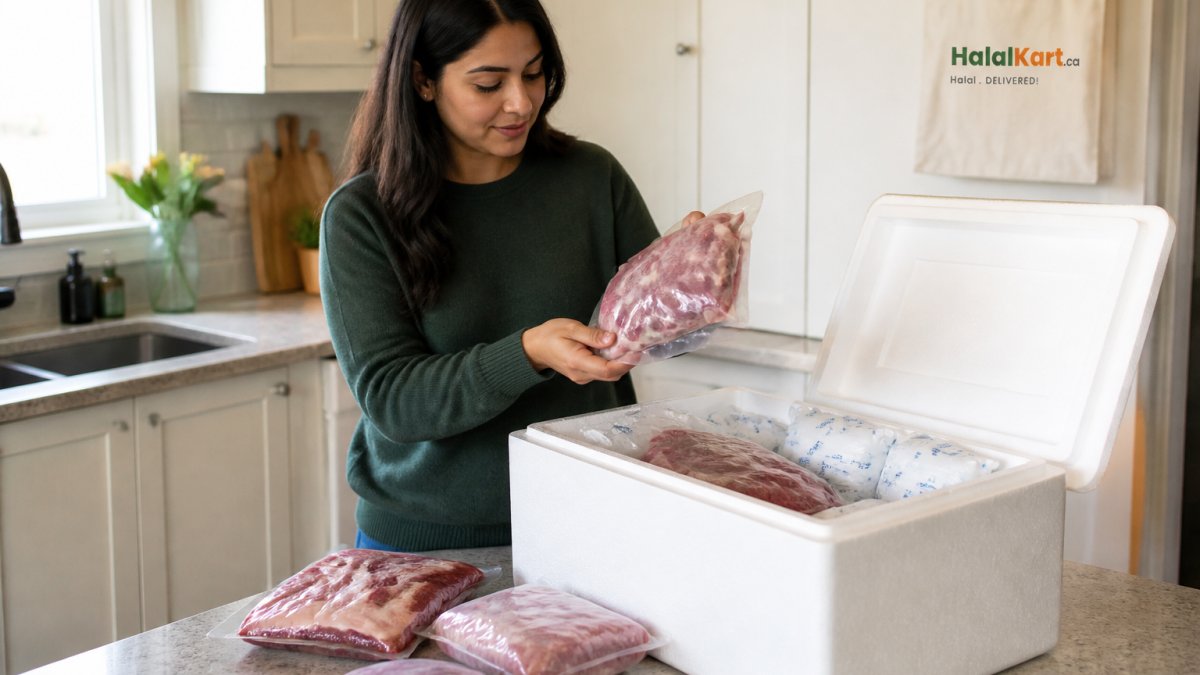
Your job starts when the box lands. Fresh meat should arrive cold to the touch, and frozen meat should show no soft spots or ice crystals from refreezing.
Cold Chain and Packaging Basics
The cold chain is the unbroken run of refrigeration from plant to your fridge. Break it, and bacteria get a head start.
Check on arrival:
- Surface temperature feels fridge-cold, not cool-room warm.
- Vacuum seals are tight, with no air pockets or leaks.
- Cold packs are still solid or mostly frozen.
- Packaging is intact, with no damp cardboard.
Move fresh meat to the fridge right away. Use it within the timeframe the supplier states, or freeze it if you will not cook it soon. Keep raw meat sealed and below ready-to-eat foods (Food safety and you).
Delivery Coverage, Cost, and Value Compared
Value is not the sticker price. It is the price plus delivery plus your time, weighed against the confidence that the meat is what it claims to be.
Compare services on these points:
| What to compare | Why it matters | What to look for |
|---|---|---|
| Delivery coverage | Suburban and rural addresses are often excluded | Clear postcode or region checker |
| Delivery fee | A low basket price can hide a high fee | Fee stated before checkout |
| Minimum order | Small households may over-buy to qualify | Low or no minimum |
| Packaging standard | Insulation decides food safety in transit | Insulated boxes, cold packs |
| Certification transparency | Tells you who verified the meat | Certifier named per product |
| Substitution policy | Protects your order when stock runs out | Contact before swapping |
Cost and value comparison is where most buyers get caught. A cheaper basket with weak packaging and no certifier named is not cheaper once you factor in risk.
For readers weighing certification bodies, the Canadian Food Inspection Agency guidance on food labelling is a useful starting point for what claims must be substantiated.
Your First Order: A Step-by-Step Walkthrough
Your first order should take ten minutes and leave nothing to chance. Here is the sequence we would follow.
- Confirm coverage. Enter your address and check the delivery window before you fill a cart.
- Verify the certifier. Trace the named body and confirm the certificate is current.
- Read the product page. Check the cut, weight, and whether the item is fresh or frozen.
- Set your substitutions. Choose whether you want contact first or a refund on out-of-stock items.
- Check the cold chain promise. Look for insulated packaging and cold packs in the delivery details.
- Place a small first order. Test quality, packaging, and timing before you buy in bulk.
- Inspect on arrival. Check temperature and seals, then store immediately.
- Keep the paperwork. Save the order confirmation and certificate reference in case of a dispute.
If something arrives wrong, contact the seller the same day with photos. A supplier serious about integrity will resolve it fast.
At HalalKart, our four-step verification process covers background checks, documentation review, partnerships with recognized monitoring organizations, and ongoing audits with community feedback.
Buying halal meat online asks you to trust a process you cannot see. You get verified halal groceries and fresh meat in one place, delivered to your door.
Frequently Asked Questions
How can you verify that meat is halal certified?
Look for a certification mark from a recognized halal monitoring body, then check that the certifier's scope covers the specific product and processing facility, not just the brand. Ask the seller which certifier they work with and request documentation. A trustworthy halal meat delivery service will name its certifiers openly and answer questions about audits. Certification should cover slaughter, processing, and handling, so confirm all three rather than assuming a logo on the package settles it.
What should you look for in a halal meat delivery service?
Check four things: who certifies the meat and whether that certification covers processing and handling, how the cold chain is maintained from warehouse to door, what the substitution and refund policy is if an item is unavailable or arrives damaged, and whether delivery reaches your area. Reviews help here. Read halal meat delivery service reviews for patterns around freshness, packaging, and customer service rather than one-off complaints. Transparent sourcing and clear certifier names are the strongest signals of reliability.
How is halal meat kept safe during delivery?
Safe delivery depends on the cold chain staying unbroken. Reputable services pack fresh and frozen meat in insulated liners with gel packs or dry ice, and they time dispatch so the box arrives within a safe window. When your order arrives, check that meat is still firm and cold to the touch, and refrigerate or freeze it promptly. If packaging is compromised or meat feels warm, contact the seller before cooking it.
How should you store halal meat after delivery?
Refrigerate fresh meat at 4°C or below and use it within the timeframe on the package, or freeze it at -18°C or lower for longer storage. Keep raw meat on the bottom shelf in sealed containers so juices cannot drip onto other food. Label frozen packages with the date, and thaw in the fridge rather than at room temperature. Handled this way, halal meat storage and handling keeps quality and food safety intact from delivery to dinner.