 Comparison
Halal Grocery Delivery vs Local Butcher: Which Fits Your Kitchen?
Last Updated: October 30, 2026
Quick Summary
Halal grocery delivery brings certified meat and pantry staples to your door through an online marketplace, while a local butcher offers counter service, custom cuts, and same-day purchase. Neither wins outright; the right choice depends on how you shop, how often you cook, and how much you value your time. Compare certification, price, cold-chain handling, and total cost before deciding.
- Verify the certifying body by name, not just the halal sign or logo.
- Build total cost as product price plus delivery fee, minimum order, and tip.
- Bulk and staple orders favor delivery because the fee spreads across many items.
- Small single-item purchases favor the butcher, with no fee or minimum.
- Many families land on a hybrid: delivery for bulk runs, butcher for special cuts.
Table of Contents
- Halal Grocery Delivery vs Local Butcher: The Trade-Offs at a Glance
- Halal-Certified Meat: How to Verify What You're Buying
- Halal Meat Prices: What Drives the Difference
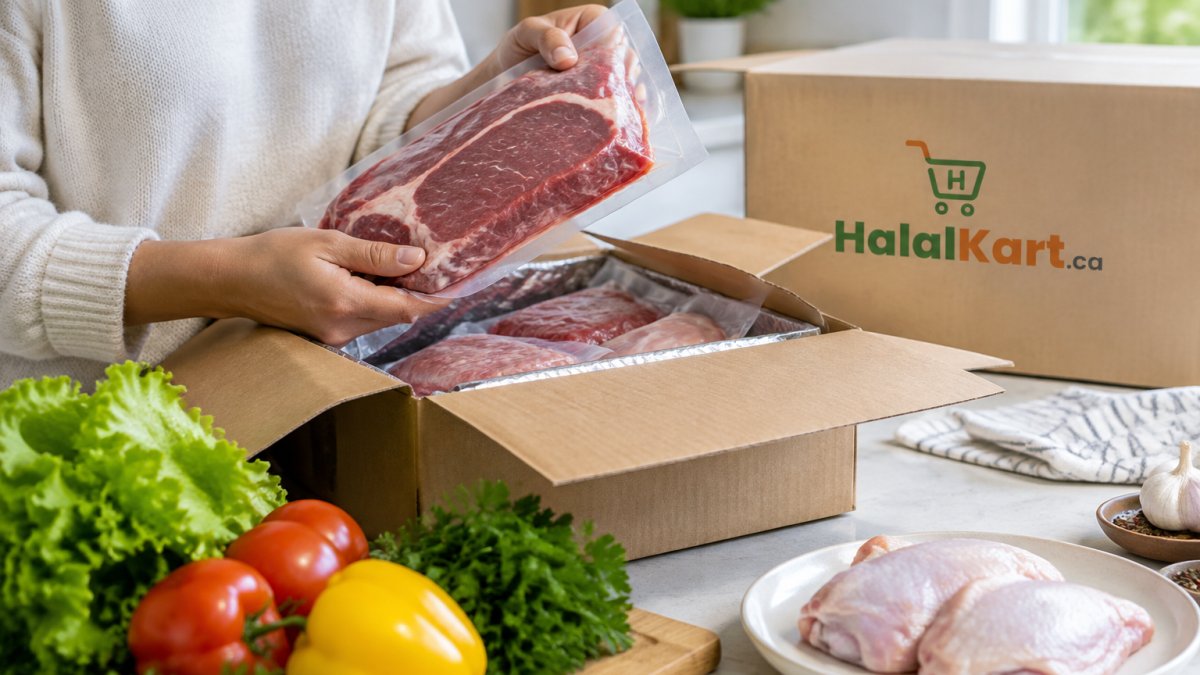
- Halal Meat Delivery: Cold-Chain Handling and Packaging
- Finding a Halal Butcher Near Me: What a Walk-In Visit Offers
- Total Cost Comparison: Delivery Fees, Minimum Orders, and Travel
- Which Option Fits Your Household and Shopping Habits
- Shop Halal on HalalKart
- Frequently Asked Questions
Halal Grocery Delivery vs Local Butcher: The Trade-Offs at a Glance
Halal grocery delivery brings certified meat and pantry staples to your door through an online marketplace, while a local butcher offers counter service, custom cuts, and a conversation across the glass. Neither wins outright. The right choice depends on how you shop, how often you cook, and how much you value your time. Below, we break down certification, price, cold-chain handling, and total cost so you can pick with confidence.
| Factor | Halal Grocery Delivery | Local Butcher |
|---|---|---|
| Certification visibility | Listed online, checkable before you buy | Ask staff, often posted in store |
| Custom cuts | Limited to listed options | Full counter service |
| Freshness timing | Depends on cold-chain and delivery window | Cut on request, same day |
| Total cost | Product + delivery fee + minimum order | Product + travel time and fuel |
| Best for | Busy households, bulk staples, suburbs | Same-day cooking, specialty cuts |
Halal-Certified Meat: How to Verify What You're Buying
Verification starts with the certificate, not the label. A trustworthy seller can show you which certifying body inspected the meat and what that body's standard covers, including hand-slaughter requirements. Many shoppers assume a halal sign settles the question. It doesn't. Ask for the certifier's name, then confirm the certifier actually exists and covers the product in front of you.
Certification Bodies and What Their Logos Mean
Logos vary widely, and a logo alone proves little. HalalKart partners with recognized monitoring organizations such as HMA, ISNA, and IFANCA. For a deeper walkthrough of reading labels, see our guide on how to identify authentic halal labels on your groceries.
Questions to Ask a Butcher or an Online Seller
A short, direct list separates serious sellers from casual ones. Ask each of these before your first order:
- Which certification body inspects your meat, and can I see the certificate?
- Is the slaughter hand-slaughtered, and who performs it?
- Where do you source your beef, chicken, and lamb?
- How is fresh meat stored and transported?
Our step-by-step guide to verifying halal meat online walks through each check in detail.
Halal Meat Prices: What Drives the Difference
Halal meat prices reflect sourcing, cut, and handling more than the halal label itself. Delivery adds logistics, and a butcher's counter price can look lower than an online listing if fees and travel are left out of the comparison.
Watch out: comparing a butcher's shelf price to an online product price without adding delivery fees and minimum orders can make the wrong option look cheaper. Build the full number first.
Halal Meat Delivery: Cold-Chain Handling and Packaging
Cold-chain handling is the make-or-break factor for online meat.
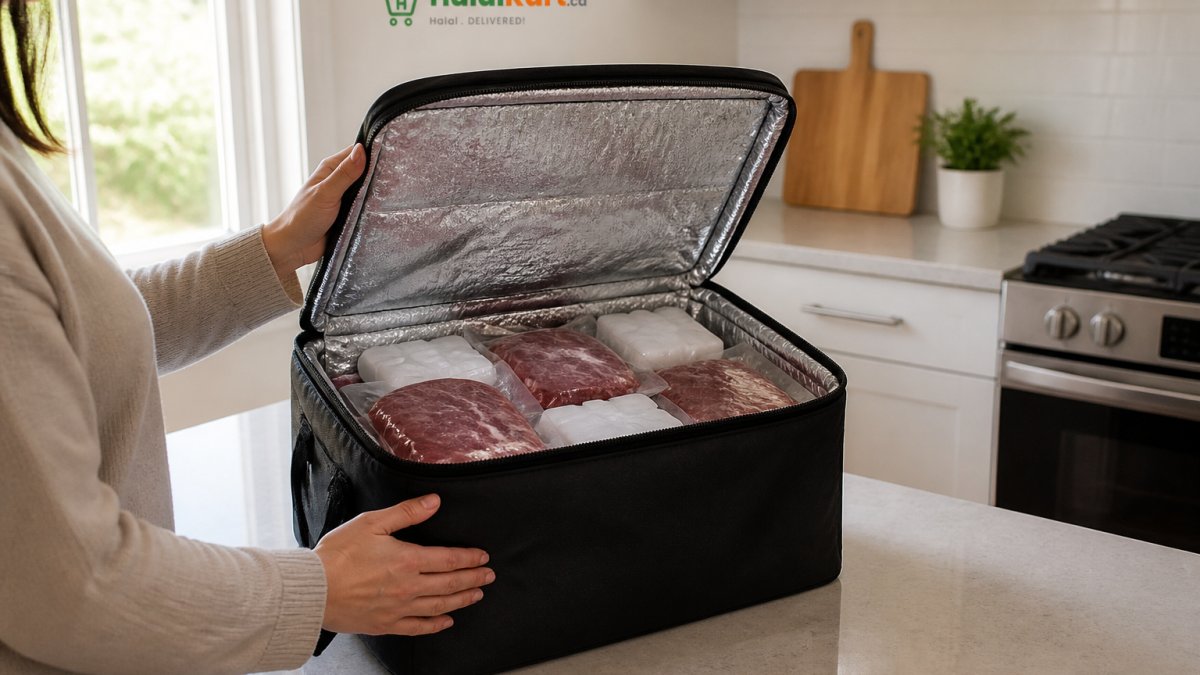
Ask how orders are packed, how long delivery takes, and what happens if a package arrives warm. Ask how your order is packed and how long delivery takes before you buy.
Finding a Halal Butcher Near Me: What a Walk-In Visit Offers
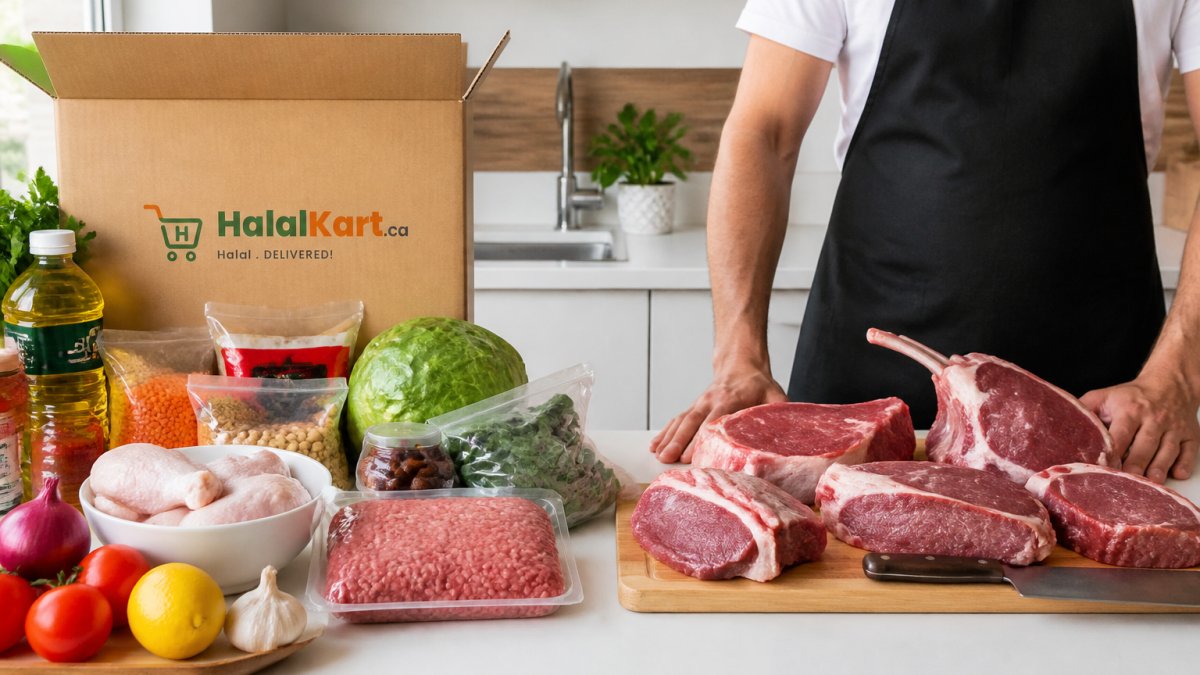
A walk-in butcher shop delivers something delivery can't: your eyes and nose on the meat. You can inspect marbling, ask for a specific cut, and take it home the same day. For a household cooking a large meal, that same-day certainty matters. Our guide to the benefits of locally sourced halal meat covers freshness and traceability in more depth.
Total Cost Comparison: Delivery Fees, Minimum Orders, and Travel
Total cost is where the two options genuinely diverge, and it is the number most shoppers never actually calculate. A butcher's shelf price and an online product price are not comparable until you add every line item on both sides. Build the full basket before you judge which is cheaper.
The Full Cost Equation
On the delivery side, the true cost is product price + delivery fee + any minimum-order shortfall + tip (if offered) + the cost of a missed delivery window.
Delivery fees and minimum orders vary by vendor and by postal code, so the most reliable method is to price your actual weekly basket both ways. Do that once and the answer for your household usually becomes obvious.
A Like-for-Like Basket Method
Pick a representative basket, say two kilograms of chicken, one kilogram of beef, a lamb shoulder, and a handful of pantry staples, and price it three ways:
- Delivery, full basket: product total + delivery fee + any minimum-order top-up.
- Butcher, meat only: counter total + fuel + parking + your time at a reasonable hourly value.
- Hybrid: meat from the butcher, staples delivered, or the reverse.
The hybrid column is the one most families overlook, and it often wins. Delivery consolidates a full grocery run and spreads the fee across many items, so the per-item logistics cost drops sharply. A single-item butcher purchase carries no fee but also no consolidation, so its effective cost per kilogram rises once travel is counted.
When Each Option Wins on Cost
- Bulk and staples favor delivery. A large order amortizes the delivery fee across dozens of items, and bulk savings are often available online.
- Small, single-item purchases favor the butcher. No fee, no minimum, and you can negotiate in person on larger cuts.
- Suburbs and long drives favor delivery. The further the butcher, the more fuel and time you burn per trip.
- Walkable neighborhoods favor the butcher. If the shop is a short walk, travel cost approaches zero and the fee-free purchase wins.
The Hidden Costs on Both Sides
Delivery carries substitution risk: if an item is out of stock, you may receive a swap you did not choose, and resolving it costs time. Butchers carry availability risk: a popular cut can sell out before you arrive, forcing a second trip. Neither cost appears on a receipt, but both belong in the comparison. For the certification side of the equation, see our guide on how to identify authentic halal labels on your groceries.
| Cost Item | Delivery | Butcher |
|---|---|---|
| Product price | Varies by cut and source | Varies by cut and source |
| Delivery fee | Applies per order | None |
| Minimum order | May apply | None |
| Travel | None | Fuel, parking, and time |
| Substitution risk | Present on out-of-stock items | None, but availability risk |
| Bulk savings | Often available | Negotiable in person |
| Best basket size | Large, consolidated | Small, single-item |
Which Option Fits Your Household and Shopping Habits
Match the option to your routine, not to a slogan. The right answer changes with household size, cooking frequency, freezer capacity, and how close a trustworthy halal shop actually is. Use the profiles below as a decision guide rather than a verdict.
Decision Guide by Household Type
- Large families cooking most nights: Delivery usually wins. A consolidated weekly order covers meat and staples in one trip, and the delivery fee spreads across a full basket. Keep a freezer inventory so you can buy in bulk when prices are good.
- Bulk buyers with a chest freezer: Delivery for the big monthly meat run, butcher for the specific cut you need this week. Freezer capacity is what makes bulk delivery pay off.
- Occasional shoppers who cook a few times a week: The butcher often wins. Small purchases avoid delivery fees and minimum orders, and you buy only what you will cook.
- Households without a nearby halal shop: Delivery is often the only practical route to certified meat. Verify the certifier before the first order, then compare packaging and freshness against your expectations.
- Same-day cooks and specialty-cut buyers: The butcher counter wins. You can inspect marbling, request a specific cut, and take it home the same day.
A Frequency-Based Rule of Thumb
A common pattern is that the more often you shop, the more the butcher's fee-free model helps on small baskets, but the more trips you make, the more travel and time you spend. The less often you shop, the more delivery's consolidation helps, provided your order clears any minimum. If you shop once a week in bulk, delivery usually wins.
Questions That Settle It Quickly
- How far is the nearest halal butcher you trust, in minutes and fuel?
- Does your usual basket clear the delivery minimum without padding it with items you do not need?
- Do you have freezer space to buy meat in bulk?
- How often does a cut sell out before you arrive?
- How much is an hour of your time worth on a weekend?
Answer those five and the choice usually makes itself. If you are still unsure, start with one delivery order and compare packaging, freshness, and total cost against your usual butcher trip. For the certification checks to run before that first order, see our step-by-step guide to verifying halal meat online.
Shop Halal on HalalKart
The challenge is finding a seller you can verify without giving up convenience. HalalKart is a halal-only marketplace where every vendor goes through background checks and documentation review, with partnerships with recognized monitoring organizations and ongoing audits. You get fresh meat and groceries in one order, delivered to your door, with the certification trail you can check before you buy. Browse the meat and poultry selection and shop halal groceries on HalalKart to see current products and delivery details for your area.
Frequently Asked Questions
Are local butchers cheaper than halal grocery delivery?
Not always once you count the full trip. A butcher's shelf price may look lower, but add fuel or transit fare, parking, and the time spent driving. Delivery adds a fee and sometimes a minimum order, yet it can cost less per week for households that order in bulk and skip the car trip. Compare the per-kilogram price plus delivery fee against the butcher price plus travel cost before deciding which is cheaper for your household.
How can I verify that meat is halal-certified?
Ask for the certifying body's name and check that the certificate covers the specific product and supplier, not just the store. Look for a logo from a recognized halal monitoring organization on the packaging or listing. For online orders, confirm the platform reviews vendor documentation and runs periodic audits. HalalKart partners with organizations such as HMA, ISNA, and IFANCA.
Is halal meat delivery as fresh as buying from a local butcher?
Freshness depends on cold-chain handling, not on whether you buy online or in person. Ask how the service packs fresh meat, how long delivery takes, and what happens if a package arrives warm. A butcher counter has the advantage of visible inspection, while a good delivery service matches it with proper packaging and timing.
Can I request custom cuts from a halal butcher or delivery service?
Many butchers cut to order on the spot, which suits specific requests like butterflied lamb or particular thickness for steaks. Online services vary: some offer a custom-cut note field at checkout, others stock only standard cuts. Check the product listing or ask customer service before ordering if you need a specific cut. For large bulk orders, both butchers and delivery platforms often accept advance requests with notice.
What should I check before ordering halal meat online?
Confirm the service area covers your address, read the delivery fee and minimum order, and check how fresh meat is packaged and kept cold. Look for the certifying body behind the halal claim and whether the platform audits its suppliers. Review the substitution and returns policy in case an item is out of stock or arrives damaged.
Ready to simplify your halal shopping? Get started with HalalKart and order verified halal meat and groceries with confidence.