 Comparison
How to Decide if Halal Meat Delivery Is Worth It
Last Updated: November 5, 2026
Quick Summary
Halal meat delivery is worth it when the premium you pay buys back enough time, certainty, and quality to beat a trip to the butcher. Compare the all-in total for a typical week's shop, not the headline delivery fee, and verify the certifying body before you order.
- Build the true cost per order from product subtotal, delivery fee, minimum order, packaging, and your time.
- A low delivery fee paired with a high minimum order can cost more than a flat fee with no minimum.
- Check for a named certifier, a current certificate with a visible expiry date, and a traceable supplier.
- If meat arrives warm, photograph it, keep the packaging, and contact the retailer before cooking or freezing.
- A subscription only saves money if the per-kilogram price beats buying the same cuts à la carte.
Table of Contents
- What You Actually Pay for Halal Meat Delivery
- Halal Meat Delivery Cost: A Line-by-Line Breakdown
- How to Verify Halal-Certified Meat Before You Order
- Fresh Halal Meat Delivery: Cold-Chain Safety and What to Do When It Fails
- Is a Halal Meat Subscription Box Worth the Commitment?
- Who Saves the Most From Delivery, and Who Should Keep Shopping Locally
- Placing Your First Verified Halal Order
- Frequently Asked Questions
What You Actually Pay for Halal Meat Delivery
Halal meat delivery is a service that brings certified halal beef, chicken, lamb, and pantry staples from a verified supplier to your door, usually for a delivery fee and often against a minimum order.
Most shoppers comparing delivery with a local butcher focus on the sticker price per kilogram.
Below, we break down each cost line, show you how to verify a certificate before you spend, and explain who genuinely saves by ordering online.
Halal Meat Delivery Cost: A Line-by-Line Breakdown
The price on the product page is only one line of your real bill. A useful halal meat delivery cost comparison adds four more: delivery fee, minimum order, packaging, and the value of your time and travel. Most guides stop at the sticker price per kilogram, which is why so many shoppers are surprised by the total at checkout.
Here's how to build the true cost per order:
- Product subtotal. Add every item you'd otherwise buy at the butcher, not just the meat. Pantry staples, marinades, and bones for stock all count if you'd buy them on the same trip.
- Delivery fee. Note whether it's flat, tiered by order size, or waived above a threshold. A fee that disappears at a spend level is really a discount you have to earn.
- Minimum order. If you must spend more to qualify, that's forced volume you may not need that week. Treat the gap between your real need and the minimum as a cost.
- Packaging and cold-chain materials. Insulated liners and ice packs are sometimes billed, sometimes built in. If they're billed, they belong in the total.
- Your time. Fuel, parking, and the trip itself have a cost, even if it never appears on a receipt. A reasonable way to value it is your hourly wage divided by the hours the trip consumes.
A like-for-like comparison you can run yourself
The only fair comparison is the same basket, same week, both channels.
| Cost line | Local halal butcher | Supermarket halal section | Delivery marketplace |
|---|---|---|---|
| Meat subtotal (same basket) | Price at counter | Price on shelf | Price on product page |
| Delivery or travel | Fuel and parking | Fuel and parking | Delivery fee |
| Minimum order | None | None | May apply |
| Packaging | Bag, often free | Bag, often free | Insulated liner and ice packs, sometimes billed |
| Time cost | Trip and queue | Trip and queue | Ordering time only |
| Cold-chain risk | You control the trip home | You control the trip home | Depends on the courier |
Consider a simple worked example using your own numbers. Add up the meat cost at your local butcher, plus your fuel, plus a value for the time the trip takes.
Watch out: a low delivery fee paired with a high minimum order can cost more than a flat fee with no minimum, because you may end up buying items you did not plan to buy.
When the math flips
Delivery stops winning when any of these is true: the delivery fee plus packaging exceeds your fuel and time cost; the minimum order pushes you to buy more than you'll use before it spoils; or the cuts you want are priced higher online than at the counter. Run the five-cut basket once a season, because fees and minimums change. A marketplace that publishes its fee schedule and minimum clearly is easier to compare than one that reveals the total only at checkout.
How to Verify Halal-Certified Meat Before You Order
Verification is the part most buyers skip, and it's the part that matters most. A halal label is a claim; a certificate with a traceable certifying body is evidence.
Run this checklist before your first purchase:
- Does the product page name the certifying organization, not just say "halal"?
- Is the certificate current, with a visible expiry date?
- Does the certificate cover the specific product and the slaughter method claimed?
- Can you trace the meat back to a named supplier or farm?
- Does the retailer explain how it audits suppliers after onboarding?
A common mistake is trusting a logo alone. Logos are easy to copy.
This is where our approach differs from a general grocery app. For a fuller walkthrough, see our guide on how to verify halal meat online.
If a product ever fails to meet the standard you were promised, it is worth reporting.
Fresh Halal Meat Delivery: Cold-Chain Safety and What to Do When It Fails
Fresh meat is only as good as the cold chain that carries it. Fresh halal meat delivery depends on keeping the meat cold from dispatch to your fridge.
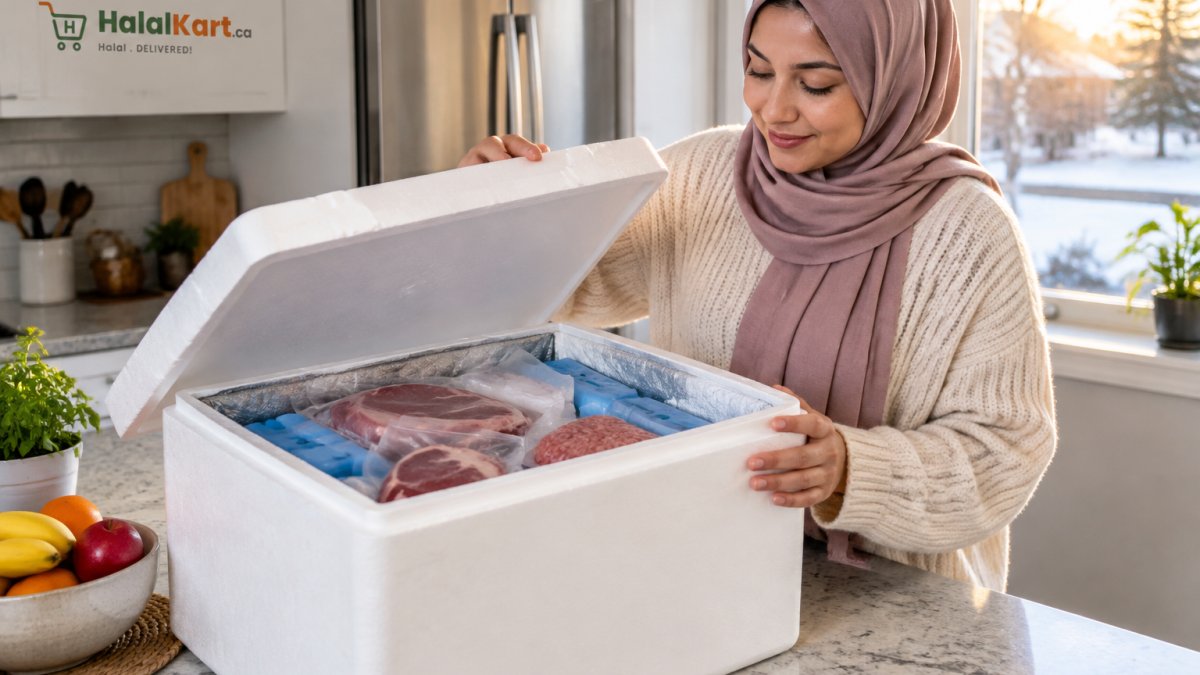
Is a Halal Meat Subscription Box Worth the Commitment?
A halal meat subscription box is a recurring delivery of a set or customizable selection of meat, usually at a fixed interval. It's worth it if you eat meat on a predictable schedule and want the convenience of never reordering; it's a poor fit if your household's needs swing week to week. The difference between a good subscription and a bad one is rarely the meat, it's the commitment terms and whether the box actually beats buying the same cuts individually.
Run the break-even math before you commit
A subscription only saves money if the per-kilogram price inside the box beats what you'd pay buying the same cuts à la carte, after you account for the commitment. Here's how to check it:
- List the cuts in a typical box and their weights. A box advertised as "10 kg of assorted meat" may be heavy on ground beef and light on the cuts you actually cook.
- Price those same cuts individually at the same retailer and at a local butcher. Use the per-kilogram price, not the box total.
- Add the delivery fee if the subscription charges one per box, and any packaging charge.
- Divide by the number of weeks the box lasts your household. If a 10 kg box lasts two weeks, the effective weekly cost is the box total divided by two.
- Compare that weekly figure with what you'd spend on the same cuts à la carte in a normal week.
A common pattern is that the box wins on convenience and loses slightly on price per kilogram unless you're buying volume cuts. If the box is within a few dollars a week of à la carte and saves you a trip, that's a fair trade for many households. If it's meaningfully more expensive and locks you in, it isn't.
Commitment terms that decide the answer
The flexibility questions matter more than the discount:
| Question | Why it matters |
|---|---|
| How often do you cook meat? | Matches box frequency to real consumption |
| Can you pause or skip a delivery? | Protects you during travel or lean weeks |
| What are the cancellation terms? | Avoids being locked into unwanted boxes |
| Is there a minimum number of boxes? | A 3-box minimum is a 3-month commitment |
| How much notice is needed to cancel? | Short notice windows are easy to miss |
| Does the box beat buying the same cuts individually? | Confirms the subscription actually saves money |
| Is the selection fixed or flexible? | Fixed boxes risk waste if cuts don't match your cooking |
Subscription flexibility is the deciding factor for most families. A box you can pause, skip, or customize fits real life; a rigid one becomes a source of waste.
Watch out: a promotional first-box price is not the subscription price. Compare the ongoing per-box cost, not the introductory offer, and check whether the promotional rate auto-renews at a higher amount.
If you're weighing options, our comparison of halal meat subscription boxes lays out how the models differ.
Who Saves the Most From Delivery, and Who Should Keep Shopping Locally
Delivery pays off for specific households, not everyone.
Local butchers still win in other cases.
The environmental angle deserves a mention too. Consolidating one delivery can cut multiple car trips, but packaging waste is real. Look for recyclable liners and consolidated shipping where you can.
For a side-by-side of the two models, our guide on halal grocery delivery versus a local butcher helps you decide which fits your kitchen.
Placing Your First Verified Halal Order
Your first order is really a test of the whole system: selection, certification, cold chain, and delivery. Start small. Order a few cuts you know well, check them against the verification checklist above, and judge the packaging and timing before you commit to a subscription.
A sensible first order:
- Pick two or three cuts you buy regularly, so you can compare quality and value directly.
- Confirm the certifier and certificate on each listing.
- Check the delivery window and cold-chain packaging on arrival.
- Keep the packaging until you've confirmed the meat is cold and sealed.
HalalKart is Canada's first halal-only online marketplace, with verified vendors, a four-step verification process, and delivery to your door. Browse our halal meat and poultry selection to place your first verified order.
Frequently Asked Questions
Is halal meat delivery more expensive than buying from a local butcher?
It depends on the order size and how you value your time. Delivery adds a delivery fee, and a larger basket spreads that fee across more meals. Compare the total cost per kilogram, including fees and minimum order thresholds, against a local butcher's counter price. For households ordering weekly in volume, the gap often narrows; for small one-off orders, a local butcher usually wins on price.
How can I verify that meat delivered online is halal-certified?
Ask the seller which certifying body inspected the supplier and request the certificate number, then check it against that organization's public records. Look for traceability from farm to slaughterhouse to packer, and confirm how the meat is labeled. A single sticker on a package gives you less to work with than a documented chain of verification.
What should I do if my halal meat delivery arrives thawed?
Check the internal temperature and the ice packs immediately on arrival. If the meat is warm to the touch or above fridge temperature, photograph the packaging and contact the seller before cooking or refreezing it. Ask the seller about its replacement or refund policy. Keep the packaging until the issue is resolved, and note whether the delay came from the courier or the packing, since that tells you whether to order again.
Are halal meat subscription boxes worth it for a family?
They work best when you already buy meat on a predictable schedule and want a fixed monthly spend. Check the box contents, the per-kilogram cost, the minimum commitment, and the cancellation terms before signing up. Flexible subscriptions that let you skip a month or swap cuts suit households with variable demand. If your family eats meat irregularly or you enjoy choosing specific cuts each week, a one-off order is usually the better fit.
The real test of halal meat delivery isn't the price tag; it's whether the service earns back your time and your trust. HalalKart combines a rigorous four-step verification process, partnerships with recognized halal monitoring organizations, and ongoing audits with convenient home delivery, so you can shop with confidence. Get started with HalalKart and put verified halal meat on your table without the guesswork.