 blog
blog
Halal Meat Subscription Boxes: A 2026 Comparison
Table of Contents
- What Makes a Halal Meat Subscription Box Trustworthy
- Halal Meat Delivery in Canada: Service Models and Coverage
- Buy Halal Meat Online: What to Expect in Box Contents and Cuts
- Halal-Certified Meat Delivery: Cold Chain and Shipping Standards
- Subscription Flexibility: Terms, Cancellation, and Recurring Delivery
- Pricing and Value Comparison Across Halal Meat Subscription Boxes
- How to Verify Halal Certification and Sourcing Standards
- Frequently Asked Questions
Last Updated: October 5, 2026
What Makes a Halal Meat Subscription Box Trustworthy
Choosing a halal meat subscription box means trusting every cut meets strict Islamic dietary standards. At HalalKart, we know that trust is earned through transparent verification, not marketing claims.
A trustworthy halal meat subscription service verifies suppliers at multiple checkpoints: documented slaughter methods, chain-of-custody records, and third-party audits.
Halal Meat Delivery in Canada: Service Models and Coverage
Halal meat delivery services operate differently depending on infrastructure and vendor network. Some focus on major urban centres with established halal butchers; others build direct relationships with smaller certified suppliers across provinces.
Coverage matters because fresh meat requires reliable cold-chain logistics. A city-only service controls temperature more easily than one shipping across provinces.
Before committing, check whether a service covers your postal code.
Buy Halal Meat Online: What to Expect in Box Contents and Cuts
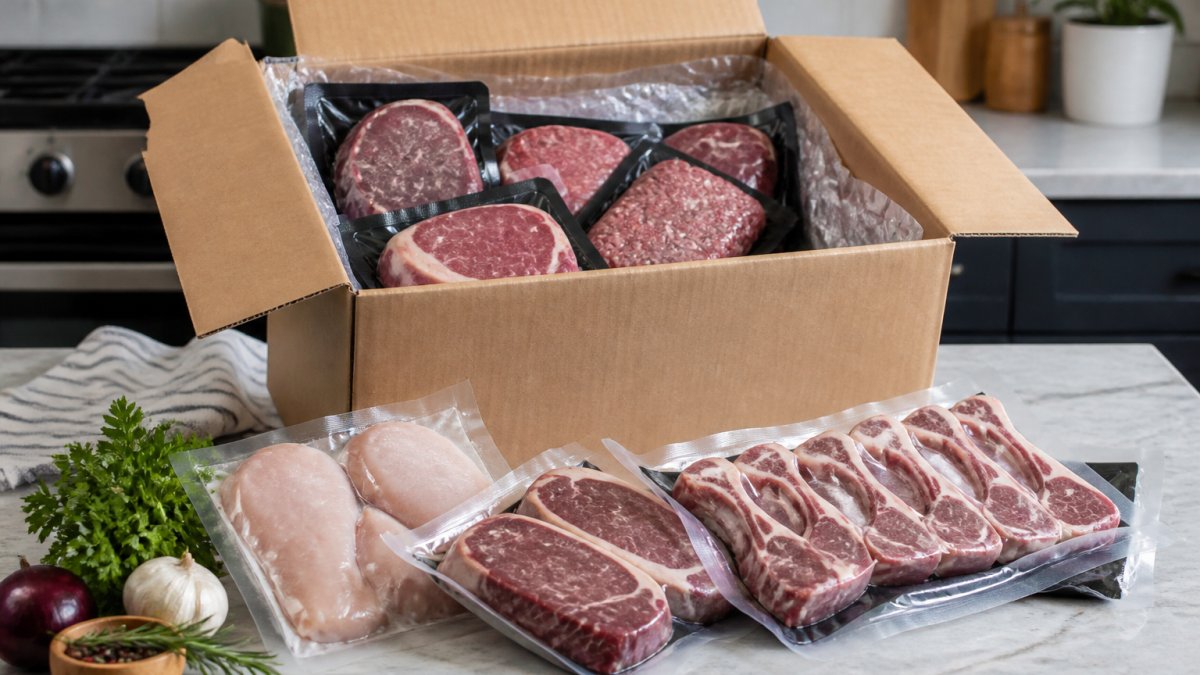
Ordering halal meat online means receiving pre-selected assortments or customizing your box based on availability. Most services run weekly or bi-weekly cycles, with some offering monthly plans for those with freezer space.
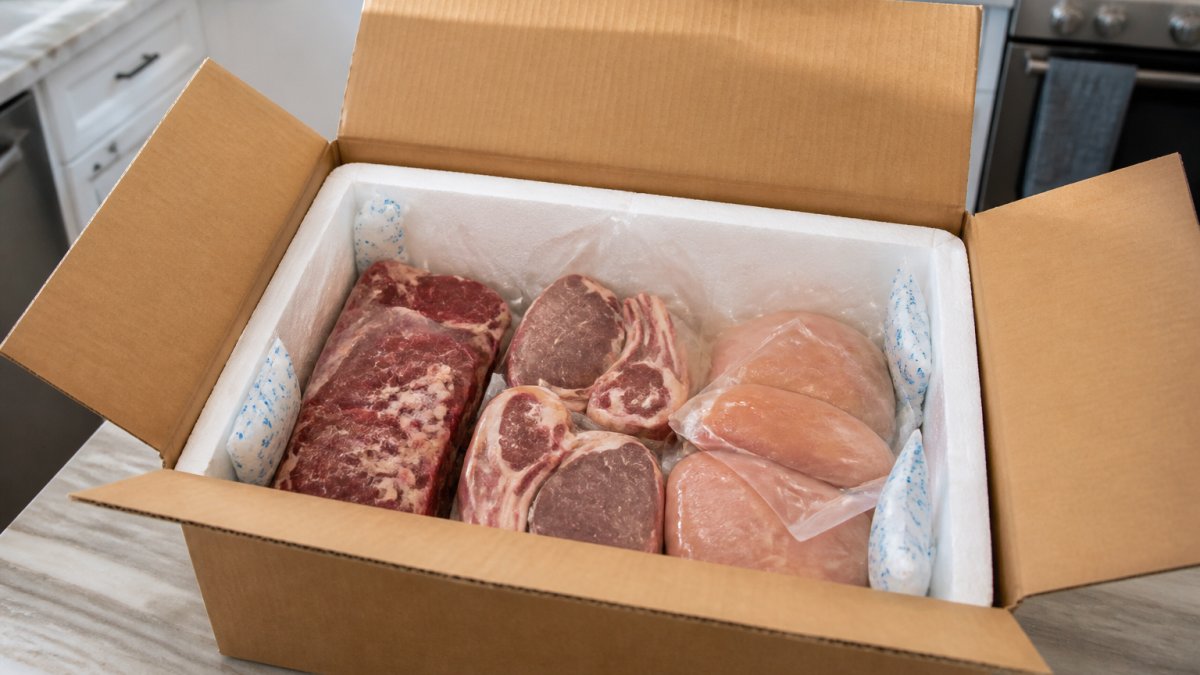
Beef, lamb, and chicken options
Beef cuts typically include premium options like ribeye, sirloin, and ground beef. Lamb offerings range from chops and leg roasts to ground lamb for kofta or curries. Chicken comes as whole birds, breasts, thighs, or ground meat. The variety depends on the service's supplier network and seasonal availability.
Quality standards vary: some services emphasize grass-fed or pasture-raised meat, others focus on certified halal sourcing without welfare claims. Check product descriptions.
Specialty items and deli products
Beyond fresh meat, many halal meat subscription boxes include prepared items such as halal sausages, smoked beef, salami, bologna, or other deli products from certified producers. Some partner with local artisans for offerings you won't find in mainstream grocers.
Specialty items add convenience if you're consolidating your halal shopping.
Halal-Certified Meat Delivery: Cold Chain and Shipping Standards
Fresh meat shipped to your home requires strict temperature control. A reliable halal meat subscription box uses insulated packaging, gel ice packs, and expedited shipping to keep meat safe in transit.
Most services guarantee delivery within 24-48 hours of shipment, a window that limits bacterial growth and preserves quality.
Ask about packaging too: quality services use food-grade insulation and non-toxic ice packs. Check return policies as well.
Subscription Flexibility: Terms, Cancellation, and Recurring Delivery
Subscription models vary widely. Some require monthly commitments, while others allow week-to-week ordering without long-term contracts. Cancellation policies matter, you should be able to pause or cancel without penalties or hidden fees.
A few services offer true flexibility, skip a week, change frequency, or modify box contents without losing your subscription.
Recurring delivery means automatic charges each cycle. Know your billing date and how to update payment methods; some services send reminders before charging and others don't, a small difference that affects your experience significantly.
Pricing and Value Comparison Across Halal Meat Subscription Boxes
Halal meat subscription pricing is hard to compare because services quote it in different units: per box, per pound, per week, per delivery, or per item. Two boxes at the same price can differ by several pounds of meat and a wide range of cut quality. Here's how to normalize the numbers.
The four numbers that determine real value
Ignore the headline price until you have these four figures for each service:
- Total box weight (in pounds). Not the number of items, the actual weight of meat. A "10-item box" can weigh less than a "6-pound box."
- Price per pound. Divide the box price by the box weight. This is the only number that compares cleanly across services.
- Shipping and membership fees. Some services fold delivery into the box price; others add it at checkout. A $0 shipping line can hide a higher per-pound price.
- Cut mix. A box heavy on ground beef and chicken thighs will have a lower per-pound cost than one heavy on ribeye and lamb chops. Compare like cuts to like cuts.
A worked example of the math
Suppose Service A charges $120 for a 10 lb box with free delivery, and Service B charges $95 for a 7 lb box plus $15 delivery.
- Service A: $120 ÷ 10 lb = $12.00 per lb delivered
- Service B: ($95 + $15) ÷ 7 lb = $15.71 per lb delivered
On paper Service B looks cheaper. Per pound delivered, Service A is roughly 24% less expensive. This is the kind of gap that disappears when you only look at the sticker price.
Now layer in cut mix.
Subscription terms that change the true cost
Price per pound is only half the equation. The other half is what the subscription commits you to:
- Delivery frequency. Weekly, bi-weekly, and monthly plans change how much freezer space and cash flow you need. A monthly plan at a higher per-pound price can be cheaper overall than a weekly plan you cannot keep up with.
- Minimum commitment. Some services require a set number of deliveries before you can cancel. Others are cancel-anytime. A lower per-pound price with a six-month lock-in is not necessarily the better deal.
- Skip and pause policies. Being able to skip a week or pause for a month is worth real money if you travel or cook irregularly. Services that charge a fee to skip are effectively raising your per-pound cost.
- Customization fees. Some services let you swap cuts for free; others charge a premium for substitutions or for excluding items you do not want.
- Cancellation fees and notice periods. Check whether cancellation requires notice (for example, before the next billing date) and whether any fee applies.
Comparison table: what to put side by side
| Factor | What to record | Why it changes the decision |
|---|---|---|
| Box price | Total charged per delivery | Baseline for all other math |
| Box weight | Pounds of meat, not item count | Enables per-pound comparison |
| Shipping fee | Per delivery, or included | Often the hidden cost difference |
| Price per pound | Box price ÷ box weight | The only apples-to-apples price metric |
| Cut mix | Share of premium vs. value cuts | Explains why per-pound prices differ |
| Frequency | Weekly / bi-weekly / monthly | Determines annual spend and freezer load |
| Minimum commitment | Number of deliveries required | Affects exit cost and risk |
| Skip / pause | Allowed? Fee? Notice? | Flexibility has monetary value |
| Cancellation | Notice period and any fee | Final cost of leaving |
| Specialty items | Deli, prepared, or add-ons included | Raises cost but adds convenience |
How to build your own comparison
Pick three services that deliver to your postal code and record the ten factors above in a spreadsheet. Calculate price per pound delivered for the box size you'd actually order, the one matching your household's weekly meat consumption. The lowest per-pound price isn't automatically the winner; weigh it against cut mix, flexibility, and certification strength.
How to Verify Halal Certification and Sourcing Standards
Most halal meat subscription roundups tell you to "look for certification" and stop there. That advice is useless without knowing what certification covers, who issues it, and how to confirm a claim is real. Here's the verification process, step by step.
What halal certification actually covers
A halal certificate is not a single stamp but a scope document specifying which products, facilities, and production lines are covered. A slaughterhouse certificate doesn't automatically cover a deli kitchen that buys from it, and a certificate for one cut doesn't cover every product a brand sells.
When you review a certificate, check four things:
- The certifying body's name and logo, not a generic "halal" badge.
- The facility or supplier named on the certificate, it should match the brand you are buying from, or a supplier the brand names publicly.
- The product scope, species (beef, lamb, chicken), product form (fresh, frozen, processed), and any exclusions.
- The validity dates, certificates expire, and an expired certificate is not a certificate.
Certification models you will encounter
Halal monitoring in Canada isn't centralized the way some food safety regimes are. Private organizations handle certification.
- On-site slaughter monitoring. An inspector is present at the abattoir during slaughter to confirm the animal is alive and healthy at the time of slaughter, that the slaughter is performed by a Muslim, that the name of God is invoked, and that the cut severs the required vessels.
- Periodic facility audits. The certifier visits the facility on a schedule, reviews records, and issues a certificate covering a period. The slaughter itself may not be witnessed every time.
- Documentation-only review. The certifier reviews supplier paperwork without visiting the facility.
When a service says "halal-certified," the useful follow-up question is: which model, and who is the certifier?
Recognized certifying bodies to look for
Several organizations are widely recognized by Muslim consumers and retailers in Canada. Commonly referenced bodies include:
- the Halal Monitoring Authority (HMA)
- the Islamic Society of North America (ISNA)
- the International Halal and Kosher Bureau (IFANCA)
This isn't exhaustive, and a service using a smaller regional certifier isn't automatically suspect.
A practical verification checklist
Before you commit to a subscription, run through these steps:
- Ask the service to name its certifier. A legitimate provider answers immediately. A vague answer ("our suppliers are all halal") is a red flag.
- Ask for the certificate scope. Confirm the certificate covers the specific products in your box, not just the brand name.
- Check the certifier's own directory. Most certifying bodies publish a list of certified producers. Cross-reference the supplier.
- Look for a certification number. Many certificates carry a unique ID you can quote when contacting the certifier directly.
- Ask how often suppliers are re-audited. Annual is common; longer gaps deserve scrutiny.
- Separate halal from welfare claims. Grass-fed, pasture-raised, organic, and antibiotic-free are animal-welfare and farming claims. They are not halal certifications, and a product can be one without the other. Do not let a welfare claim substitute for a halal certificate.
Why this matters more for subscription boxes than one-off orders
With a single purchase, a verification mistake is a one-time problem. With a recurring subscription, you re-buy the same trust every cycle. That's why the strongest services publish certification standards, name their certifiers, and share supplier documentation on request.
Frequently Asked Questions
How can I verify that a halal meat subscription box is actually halal-certified?
Look for third-party halal certification from recognized monitoring organizations such as HMA (Halal Monitoring Authority), ISNA (Islamic Society of North America), or IFANCA (Islamic Food and Nutrition Council of America). Verified providers display certification documentation and undergo regular audits. Request proof of certification and slaughter standards from the supplier before ordering. Transparent companies will provide detailed sourcing information and certification details on their website or upon request.
What should I look for in a halal meat subscription box?
Prioritize verified halal certification from recognized organizations, transparent sourcing and slaughter standards, a variety of cuts and meat types (beef, lamb, chicken), flexible subscription terms with easy cancellation, reliable cold-chain shipping to prevent spoilage, clear pricing without hidden fees, and delivery availability to your area. Check customer reviews for reliability and product quality. Ensure the provider offers detailed product information and responsive customer service for any concerns about halal integrity.
Can I choose specific cuts in a halal meat subscription box, or is it a fixed assortment?
Most halal meat subscription boxes offer both options: curated boxes with pre-selected assortments and customizable boxes where you select your preferred cuts and quantities. Customizable options give you control over beef cuts, lamb portions, chicken varieties, and specialty items like sausage or deli products. Check the provider's website to see if you can swap items, add premium cuts, or skip certain deliveries. Flexibility varies by service, so compare subscription terms before committing.
How does halal meat delivery ensure freshness and prevent contamination during shipping?
Reputable halal meat delivery services use insulated packaging with professional-grade ice packs or gel packs to maintain safe temperatures throughout transit. Meat is vacuum-sealed or wrapped to prevent cross-contamination. Delivery timeframes are typically 1-3 days to minimize thaw risk. Upon arrival, inspect packaging for damage and check that meat is still cold to the touch. Immediately refrigerate or freeze the contents. Providers should offer guarantees on product quality and replacement policies if meat arrives compromised. Always verify the cold-chain handling standards before ordering.