 How-to
Convenient Halal Shopping for Modern Muslims
Table of Contents
- A Practical Halal Grocery Shopping Checklist
- How to Verify Halal Certification Without Guesswork
- Halal Groceries Online: Comparing Your Convenience Options
- Inside the Halal Supply Chain Process
- Finding Halal Groceries, Meat, and Restaurants Near You
- Budgeting and Meal Planning for a Halal Household
- Building Confidence in Every Order
- Frequently Asked Questions
Last Updated: October 21, 2026
A Practical Halal Grocery Shopping Checklist
Convenient halal shopping for modern Muslims starts with a simple shift: treat it as a repeatable routine, not a weekly scramble. At HalalKart, we built our marketplace around that idea.
Halal shopping is the practice of buying food and household goods that meet Islamic dietary requirements, from verified meat to packaged goods with checked ingredients.
Here is the core checklist we recommend:
- Review what you used up this week
- Check your freezer and pantry before ordering
- List meat, bread, and everyday essentials separately
- Confirm certification marks on any new product
- Set a budget range before you open the app
- Schedule delivery for a day you are home
That is the whole system. Everything else in this guide makes each step faster.
Before You Shop: Know Your Household Needs
A quick inventory saves more time than any coupon. Walk your kitchen once a week and note what actually ran out.
Most households over-order fresh items and under-order basics. Bread, milk, rice, and cooking oil disappear fastest, so list those first.
Keep a running list on your phone. Add to it the moment something finishes. By the time you order, the list is already done.
At the Store or Online: A Quick Verification Routine
Check the certification mark before the price. That one habit prevents most buying mistakes.
A common mistake is trusting a front-of-pack word like "halal" without a recognized certification logo. Look for a certifying body's mark, then confirm the product name matches.
How to Verify Halal Certification Without Guesswork
Verification is the part most guides skip. To verify halal certification, match the product to a recognized certifying body, confirm the mark is current, and check that the certified item is the one you are holding. Anything unclear gets set aside.
Reading Product Labels and Certification Marks
Start with the logo, not the marketing copy. Recognized halal monitors publish the brands and products they certify, so cross-check the exact product name.
Watch for these signals:
- A certifying body's logo with a reference number
- The word zabihah on meat packaging, meaning the animal was slaughtered according to Islamic requirements (Halal vs. Zabiha: Is There a Difference?)
- Ingredient lists naming alcohol, gelatin, or unspecified enzymes
- "Suitable for vegetarians" claims that say nothing about certification
What to Do When an Ingredient Is Unclear
Contact the brand directly. Ask which certifier covers that specific product and request written confirmation.
If the answer is vague, treat the item as not confirmed and choose an alternative. That is not paranoia. It is the same standard you would apply to any allergen.
This is where our 4-step verification process matters. We review vendor documentation, check certification against recognized monitoring organizations, run background checks on suppliers, and keep monitoring through periodic audits and community feedback.
Halal Groceries Online: Comparing Your Convenience Options
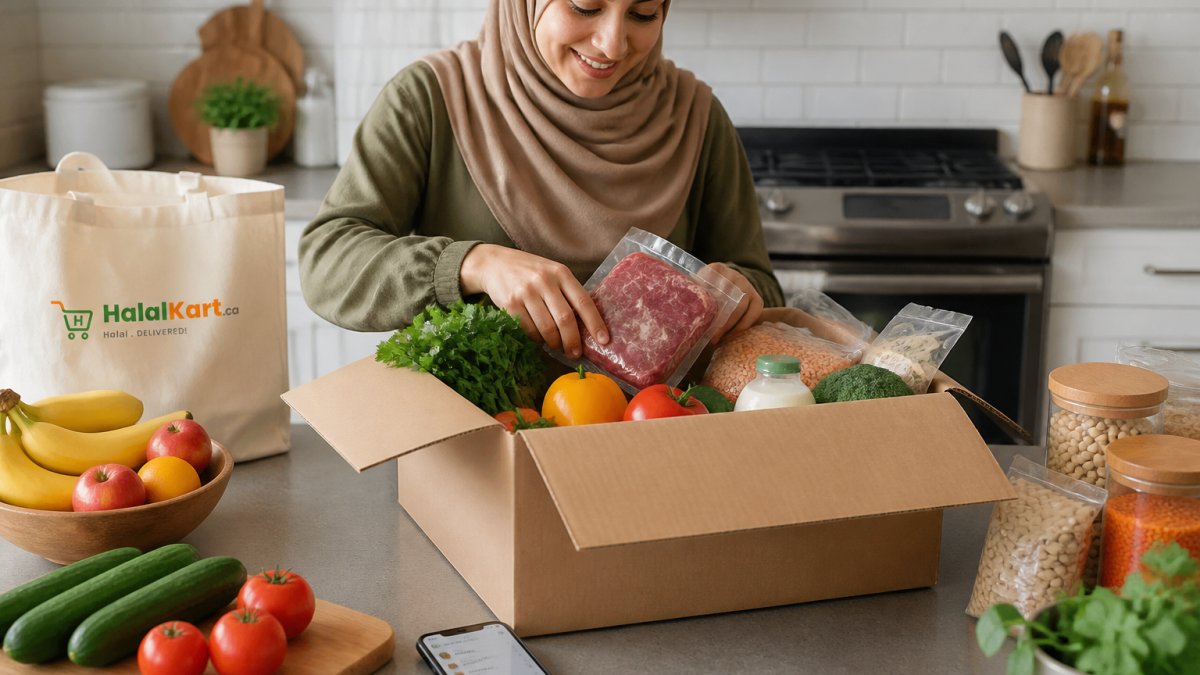
Online halal grocery shopping comes down to four practical choices: a dedicated halal marketplace, a general grocery delivery app, a local store with its own pickup or ordering, and in-store shopping at a supermarket or halal butcher.
Here is how they compare in practice:
| Option | Verification depth | Variety | Typical timing | Likely extra costs | Best for |
|---|---|---|---|---|---|
| Dedicated halal marketplace | Deep, supplier-level checks and certifier cross-references | Halal-focused range plus everyday essentials | Scheduled delivery windows, often next-day | Delivery fee plus possible minimum order; check current rates at checkout | Families who want certainty on meat and packaged goods |
| General delivery app | Store-dependent, rarely halal-specific | Very broad, but halal items are a small slice | Same-day in many urban zones | Delivery fee, service fee, small-order fee, and tip | Filling gaps fast when you already know the brand |
| Local store ordering or pickup | Varies by shop; ask who certifies their suppliers | Strong on fresh meat and bread | Same-day pickup, short delivery radius | Pickup is usually free; delivery may have a flat fee | Same-day top-ups and fresh cuts |
| In-store supermarket or butcher | You check the label yourself | Widest, but halal range varies block by block | Immediate | Your time and travel; no delivery fee | Comparing unit prices and inspecting fresh meat |
A few practical rules of thumb make the choice faster:
- Count the true cost, not the sticker. A delivery fee plus a service fee plus a tip can add a meaningful percentage to a small order. Compare the final checkout total against the in-store shelf price before you commit.
- Match the method to the item. Use a dedicated marketplace or a trusted local butcher for meat and any product where certification matters. Use a general app only for brands you have already verified.
- Check the delivery window against your schedule. A missed delivery window can mean melted frozen goods or a rescheduled order, so pick a slot when someone is home.
- Confirm the delivery zone before you build a cart. Suburban and rural addresses often fall outside same-day zones, and a dedicated marketplace may have a wider or narrower radius than a general app.
- Keep one backup method. If your main platform is out of a staple, a local store pickup is usually faster than waiting for a restock.
For a household running a weekly routine, the most convenient pattern is usually a dedicated marketplace order for meat and verified packaged goods, plus one local pickup for fresh bread and produce. That combination keeps verification high and avoids paying delivery fees on small top-up orders.
Inside the Halal Supply Chain Process
The halal supply chain process is the chain of checks that keeps a product halal from farm to shelf.
Where it breaks is at the handoffs. A certified slaughterhouse means little if a warehouse stores halal meat beside non-halal product. That is why documentation and periodic audits matter more than a single logo.
Ask any retailer two questions: who certifies their suppliers, and how often they re-check. Vague answers are a warning sign.
Finding Halal Groceries, Meat, and Restaurants Near You
Search results for "halal near me" are a starting point, not a verdict. Local availability varies block by block, so confirm before you drive.
A practical approach:
- Use map searches for halal restaurant and halal meat separately
- Check recent reviews for certification mentions
- Call ahead for fresh meat cuts and butcher hours
- Ask your local Muslim community group for current recommendations
- Confirm delivery zones if you are in the suburbs
For Muslim community members new to an area, including students and newcomers, a local mosque or community center is often the fastest source of trusted recommendations.
Budgeting and Meal Planning for a Halal Household
Value-focused shopping beats bargain hunting. Plan meals around what is on hand, then buy to fill the gaps, and compare unit prices, not package prices, so you are not paying for convenience you did not need.
A Weekly Rhythm That Works
- Pick five dinners your household actually eats
- Check which ingredients you already have
- Buy meat in family packs and freeze in meal portions
- Build one meatless dinner into the week
- Order shelf-stable essentials in larger sizes
- Review the week's receipts and note which items went unused
That last step is the one most households skip, and it is where the savings hide. A common pattern is buying fresh herbs or salad greens with good intentions and throwing half away. Buying only what the week's plan calls for usually beats a larger haul that spoils.
Compare Unit Prices, Not Package Prices
Unit pricing is the single most useful budgeting habit for a halal household, because halal meat and specialty goods often come in different pack sizes across retailers. The shelf label or product page usually shows a price per 100 g or per kg, compare that number, not the total at the bottom of the pack.
- A larger family pack is only cheaper if you will actually use or freeze it before it spoils.
- Specialty halal products sometimes carry a premium for certification; check whether a certified alternative from a larger brand is available at a lower unit price.
- Delivery fees and minimum orders can erase the savings of a bulk order, so compare the final checkout total against the in-store shelf price.
Routines for Different Households
Families with children. Cook once, portion twice. A large batch of a staple dish covers dinner and lunches, and freezing half cuts both waste and midweek takeout.
Students and newcomers. A small freezer and a limited pantry change the math.
Busy professionals. Schedule one delivery slot a week and build the meal plan around it. Pre-portion meat on the day it arrives, and keep two or three shelf-stable backup meals for the nights a plan falls through, that is cheaper than a last-minute delivery order.
Pricing on any platform depends on quantity, cuts, delivery, and current promotions, so check current prices before you commit. The goal is not the lowest possible bill every week, it is a repeatable routine that keeps halal standards high and food waste low.
Building Confidence in Every Order
Confidence is the real product here. A verified marketplace, clear certification, and a delivery you can trust turn halal shopping from a chore into a routine.
That is what HalalKart is built for: a halal-only marketplace with verified groceries, fresh meat, and lifestyle products from local artisans, delivered to your door.
If something ever falls short, our community feedback channel is part of how we keep standards honest.
Frequently Asked Questions
How can I make halal grocery shopping more convenient?
Start by building a repeatable routine: keep a running list of everyday essentials, batch your shopping into one weekly order, and use a platform that carries both groceries and household items so you are not visiting multiple stores. Online ordering with home delivery removes the trip entirely. Before you commit, check that the retailer publishes how it verifies halal certification, since convenience means little if you still have to second-guess every product label.
How can I verify that a product is halal-certified?
Look for a certification mark from a recognized halal monitoring body on the packaging, then confirm the certifier actually covers the product type and facility listed. Certification should be tied to a specific production site, not just a brand name. If a label shows a logo but no certifier name, or the mark does not match the product category, treat it as unverified. When in doubt, contact the retailer and ask which certifier approved the item and when the certificate was last reviewed.
What should I check when buying halal food online?
Check three things before ordering: whether the platform explains its verification process, whether fresh meat is shipped in temperature-controlled packaging, and whether there is a clear policy for refunds or replacements if an item does not meet halal standards. Also confirm delivery coverage for your area, since some specialty grocers only serve city cores. A user-friendly website with product-level certification details is important.
How can I shop for halal food while staying within my grocery budget?
Plan meals for the week before ordering so you buy ingredients you will actually use, and prioritize staples like bread, rice, produce, and meat products in larger quantities where it makes sense. Compare the total cost of an online order, including delivery, against the fuel and time of visiting several stores. Many households find one consolidated weekly delivery cheaper than three separate trips. Pricing varies by order size and delivery window, so check current rates directly with the retailer.
Halal shopping should not require a research project every week. The challenge is finding one source you can trust for verified groceries, fresh meat, and everyday essentials without driving across town. HalalKart solves that with a halal-only marketplace, a rigorous 4-step verification process, and delivery to your door. Get started with HalalKart and shop with confidence today.